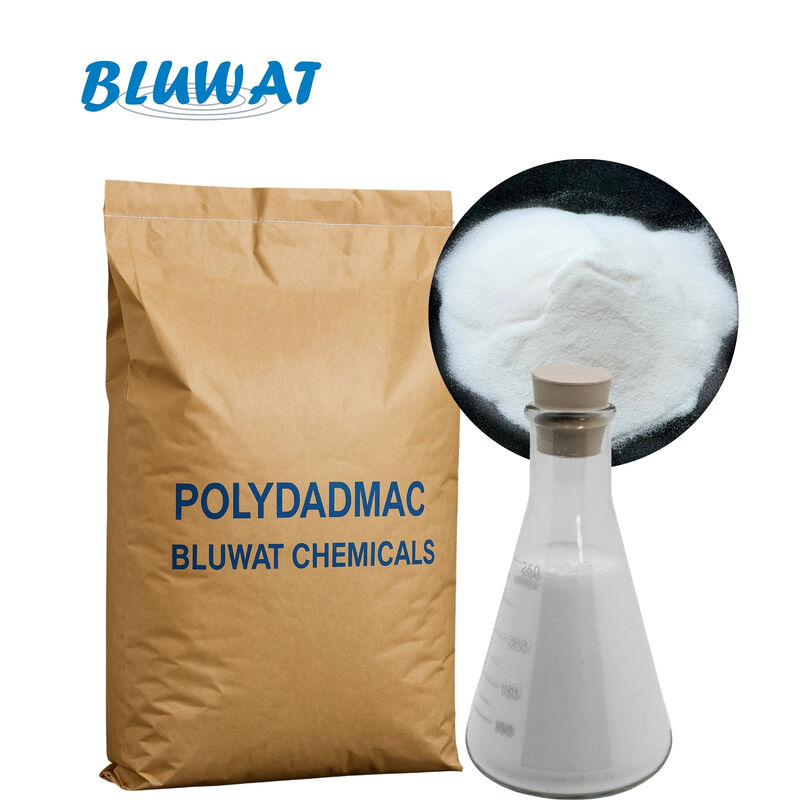
Product Details
Place of Origin: China
Brand Name: Bluwat
Certification: ZDHC/ISO/NSF
Model Number: Polydadmac Beads
Payment & Shipping Terms
Minimum Order Quantity: 1000KG
Price: negotiable
Packaging Details: 25 kg kraft bag with PE liner or 750 kg big bag
Delivery Time: 15 days
Payment Terms: L/C , T/T, DP, DA
Supply Ability: 50000 tons/month
Appearance: |
Bead-Type |
CAS No.: |
26062-79-3 |
Solid Content: |
≥90% |
PH: |
3-7 |
Viscosity: |
Low Or High |
Application: |
Water Treatment / Oil Drilling / Mining |
Appearance: |
Bead-Type |
CAS No.: |
26062-79-3 |
Solid Content: |
≥90% |
PH: |
3-7 |
Viscosity: |
Low Or High |
Application: |
Water Treatment / Oil Drilling / Mining |
P-Dadmac bead-type polymers—also known as Polydadmac beads or cationic quaternary polymer granules—represent a modern, high-performance solution for water purification, industrial wastewater treatment, and sludge management. With superior charge density, high solid content, and a stable granular form, this polymer is engineered to deliver fast, reliable, and cost-effective coagulation and flocculation results.
Bead-type Polydadmac is widely used across municipalities and industries that require strong particle destabilization, improved clarity, and efficient solid–liquid separation.
P-Dadmac is a granular, solid cationic polymer based on poly (diallyldimethylammonium chloride). Unlike liquid polymers, the bead form provides long-term stability, easier transportation, and consistent dissolution behavior.
Key physical and functional traits include:
Granular / bead-type structure for clean handling
High active content (typically ≥90%)
Strong quaternary ammonium cationic charge
Effective across wide pH conditions
Fast coagulation response with efficient floc formation
Non-corrosive and environmentally safer compared with alum or ferric salts
Its strong charge density makes it highly effective at neutralizing negatively charged colloids, dyes, organic substances, and fine suspended solids.
The quaternary ammonium groups provide rapid charge neutralization, accelerating coagulation and improving water clarity.
P-Dadmac beads generate compact flocs that settle or float quickly, improving sedimentation and flotation efficiency.
Due to its high activity, only a small amount is required, reducing total chemical consumption and lowering long-term operational costs.
Beads are stable, non-dusting, and do not degrade easily—making inventory management safer and more convenient.
Compatible with polyaluminum chloride (PAC), aluminum-based coagulants, and multi-stage treatment systems.
By enhancing flocculation efficiency, the polymer helps reduce sludge production and improves sludge dewatering performance.
Turbidity removal
Surface water and river water clarification
Pretreatment for filtration systems
Suitable for industries such as:
Textile dyeing
Cosmetics & personal care production
Food and beverage processing
Petrochemical and chemical manufacturing
Electronics & semiconductor fabrication
Used for thickening and clarifying water from:
Coal washing
Gold, copper, lithium, and diamond processing
Tailings and concentrate management
Oil–water separation enhancement
Produced water clarification
Retention aid
Charge control in wet-end processes
Helps improve solids capture and achieve drier sludge cakes.
P-Dadmac granular polymers typically feature:
Appearance: White bead-like granules
Cationic type: Strong quaternary polymer
Active content: 90%–92% (depending on grade)
Molecular weight options: Low to high
Viscosity: Multiple grades available
Storage stability: Long shelf life under dry and shaded conditions
These characteristics make it adaptable for both simple and complex water treatment systems.
25 kg kraft paper bags with PE liner
750 kg jumbo bags for bulk usage
Store in a dry, cool environment
Protect from moisture, heat, and direct sunlight
Proper storage ensures long-term polymer stability and maintains its high performance.
The popularity of bead-type Polydadmac comes from its ability to deliver:
Faster clarification and improved water quality
Lower chemical usage and treatment costs
More stable and safer handling than liquids
Strong adaptability to diverse industries
High efficiency even in challenging wastewater conditions
It is one of the most dependable and versatile cationic quaternary polymers available for modern water treatment facilities.