


 english
 français
 Deutsch
 Italiano
 Русский
 Español
 português
 Nederlandse
 ελληνικά
 日本語
日本語
 한국
한국
 العربية
 हिन्दी
 Türkçe
 indonesia
 tiếng Việt
 ไทย
ไทย
 বাংলা
বাংলা
 فارسی
فارسی
 polski
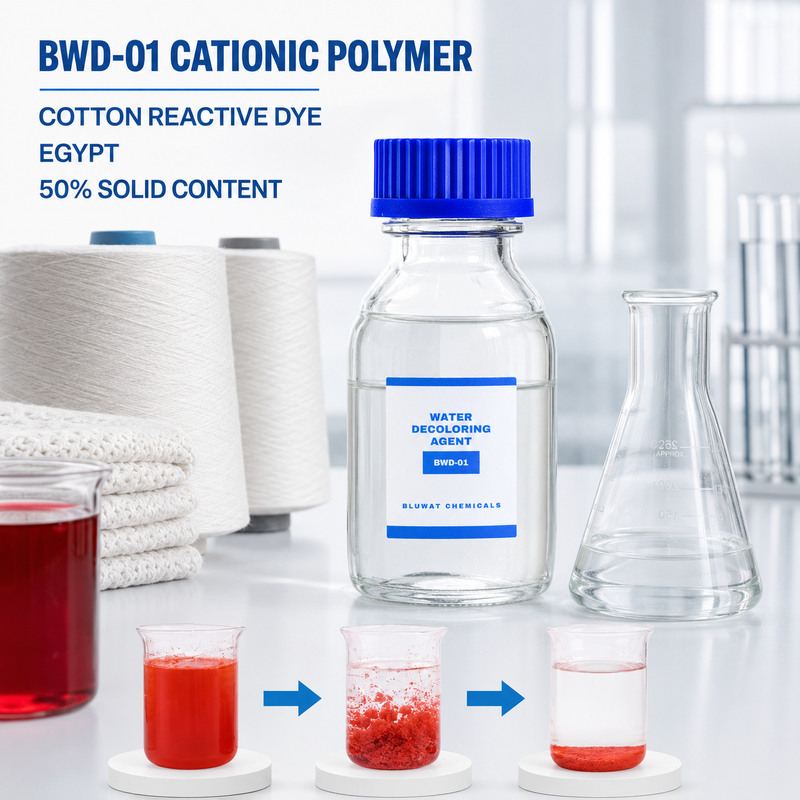
Cotton reactive-dye effluent
Cotton yarn and fabric wastewater containing soluble unfixed reactive dyes.

|
| Brand Name: | Bluwat |
| Model Number: | BWD-01 |
| MOQ: | 1000KG |
| Price: | Negotiable |
| Delivery Time: | 5-8 working days |
| Payment Terms: | L/C, D/A, D/P, T/T |
A jar-test-driven organic decolorant program for reactive and direct dyes used on cotton, home-textile printing wastewater and mixed wet-processing effluent after pH stabilization.
Textile wet processing in Egypt does not create one uniform wastewater. Fiber type, dye class, shade depth, washing recipe and finishing chemistry can change the color and charge demand from one production batch to the next.
BWD-01 supplies strong cationic charge to destabilize negatively charged soluble dyes and fine color-bearing particles. It is especially relevant to reactive and direct dyes used on cotton. The objective is not merely to make the sample look clearer, but to produce flocs that can be separated reliably by sedimentation or dissolved-air flotation.
The central treatment problem is that deep cotton shades and extensive rinsing create soluble residual color and CODcr that may remain after conventional coagulation. Inorganic coagulants may remove suspended solids while leaving a visible soluble-color fraction. Increasing coagulant dosage can then create more sludge without proportional color improvement.
Equalize and adjust the wastewater to the TDS starting pH range, then use BWD-01 to target dissolved anionic color.
The selected program should be based on actual wastewater rather than a universal dose. A controlled jar test identifies the point where charge neutralization, floc formation, separation speed and sludge production are balanced. PAC can be tested before or after BWD-01, but both products must be prepared and dosed separately.
| Property | BWD-01 Specification |
|---|---|
| Chemical name | Quaternary ammonium cationic polymer |
| Appearance | Colorless to yellowish translucent liquid |
| Solid content | 50% min |
| Specific gravity at 20 C | 1.1-1.3 |
| pH value, 30% solution | 3-6 |
| Viscosity at 25 C | 30-300 cps |
| Solubility | Soluble with water at any rate |
| Storage temperature | 0-35 C |
| Standard package | 30 kg or 250 kg plastic drum; 1250 kg IBC |
Cotton yarn and fabric wastewater containing soluble unfixed reactive dyes.
Color-bearing wastewater from home-textile printing, rinsing and machine cleaning operations.
Equalized dyeing, washing and finishing streams after pH stabilization.
Cationic groups interact with negatively charged reactive and direct dyes used on cotton and colored colloids.
Reduced electrostatic repulsion allows dissolved or finely dispersed color bodies to associate.
Destabilized contaminants form visible aggregates. PAC may strengthen or densify flocs where testing supports it.
The resulting flocs are removed by sedimentation or dissolved-air flotation to produce clearer treated water.
Measure and record wastewater pH before every dosage comparison.
Test concentrated dark-shade wastewater separately from the general equalized stream.
BWD-01 targets color and flocculation; it does not remove dissolved textile salts.
Collect representative wastewater after appropriate screening and equalization.
Dilute BWD-01 with 10 to 40 times clean water and prepare several test concentrations.
Use pH 7.5-8.0 as the TDS starting range, then test nearby values where necessary.
Add BWD-01 to the wastewater and mix thoroughly for several minutes.
Test PAC before and after BWD-01 in separate beakers. Do not premix the chemicals.
Allow flocs to settle or evaluate them by DAF, matching the site's full-scale process.
Review final color, CODcr, turbidity, floc strength, separation time, sludge volume and treatment cost.
Actual removal depends on dye class, concentration, auxiliaries, pH, mixing, chemical sequence and separation equipment.
These values are indicative for suitable applications and are not guaranteed operating results.
Manufacturer since 2000 with long-term water-treatment chemical production and export experience.
Multiple production sites support stable supply, batch control and flexible packaging options.
Products exported to more than 80 countries and used by over 5,000 industrial customers.
ISO 9001 and ISO 14001 systems with ZDHC-conformant BWD product support.
Appearance, solid content, specific gravity, pH, viscosity and solubility are supported by batch COA.
Free samples and support for dosage comparison, chemical sequence and full-scale trial planning.
Standard BWD-01 supply in 30 kg and 250 kg plastic drums or 1250 kg IBC containers.
Practical dilution and dosing procedures, sample-based selection, drum or IBC planning and commissioning support for new or expanding ETPs.