logo
Good price  online

products details

Created with Pixso. Home Created with Pixso. Products Created with Pixso.
Anionic Polyacrylamide
Created with Pixso. Blufloc C8020 Cationic Polyacrylamide CPAM Polyelectrolyte for Sludge Thickening

Blufloc C8020 Cationic Polyacrylamide CPAM Polyelectrolyte for Sludge Thickening

Brand Name: Bluwat
Model Number: C8020
MOQ: 1 Ton
Price: negotiable
Delivery Time: 5-8 Working Days
Payment Terms: L/C,D/A,D/P,T/T
Detail Information
Place of Origin:
China
Certification:
ZDHC, Halal, ISO
Appearance:
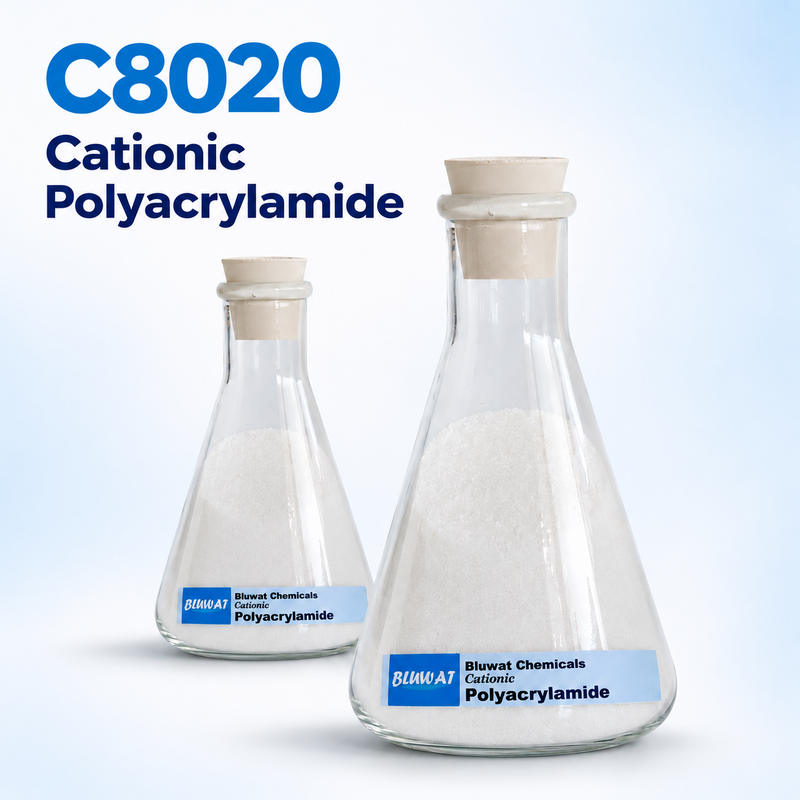
Off-white Granular Powder
Ionic Charge:
Cationic
Particle Size:
20-100 Mesh
Molecular Weight:
High
Charge Degree:
Medium
Solid Content:
89% Minimum
Bulk Density (TDS Unit Not Stated):
About 0.8
Specific Gravity At 25°C:
1.01-1.1
Recommended Working Concentration:
0.1-0.5%
PH (Test Concentration Not Stated):
4-9
Storage Temperature:
0-35°C
Packaging Details:
25 kg Kraft paper bags with inner plastic liners
Product Description
BLUFLOC · CATIONIC POLYACRYLAMIDE

Blufloc C8020 Cationic Polyacrylamide CPAM Polyelectrolyte for Sludge Thickening

Medium-charge polymer for thickening and water recovery

Blufloc C8020 is a cationic polyacrylamide (CPAM) polymer flocculant supplied as off-white granular powder with at least 89% solids. The TDS lists a 15-25% cationic charge range for evaluating clarification, sludge thickening and dewatering. Also described as a cationic polyelectrolyte, it is selected by testing the actual feed and separation task.

Molecular-weight class
High
Cationic charge
15-25%
Solid content
89% min.
Working concentration
0.2-0.5%

What Is Blufloc C8020?

Blufloc C8020 is a high molecular weight cationic polyacrylamide with a medium charge degree of 15-25%. This CPAM powder is supplied as a free-flowing, off-white granular copolymer for evaluating flocculation, clarification and sludge separation.

Related product names: Cationic Polyacrylamide · Cationic PAM · CPAM · Cationic Polyelectrolyte · Polymer Flocculant.


C8020 Product Highlights

Defined grade identity

Cationic polyacrylamide sold as Blufloc C8020, with a High molecular-weight classification in the property table.

Grade-specific charge entry

Cationic charge degree: Medium (15-25%). Compare this specification with the actual application response.

Powder supply format

Off-white granular powder, 20-100 mesh, with 89% minimum solid content. Packaging is selected from the options listed for this grade.

C8020 Technical Specifications

Property Grade-specific TDS value
Product grade Blufloc C8020
Appearance Off-White Granular Powder
Ionic Charge Cationic
Particle Size 20-100 Mesh
Molecular weight (TDS classification) High
Cationic charge degree Medium (15-25%)
Solid Content 89% Min.
Bulk density (unit not stated in TDS) About 0.6-0.8
Specific Gravity at 25°C 1.01-1.1
Recommended Working Concentration 0.2-0.5%
pH (Test concentration not stated) 4-6
Shelf Life 2 years

Molecular weight is given as a TDS classification, without a numerical range. Bulk-density units are not specified in the supplied document. The specific-gravity entry gives 25°C but no sample concentration. The pH test concentration is not stated; confirm it for specification comparisons.

C8020 Applications and Process Guidance

The C8020 application list covers raw-water clarification, industrial and sewage-sludge thickening and dewatering, paper retention, sugar mud settling, and mining or metallurgy water recovery and sludge treatment. For a thickening duty, define the required liquid quality and solids-handling outcome before selecting a dose. For dewatering, include the actual filtration or separation arrangement in the qualification.

Raw water and wastewater clarification

The supplied TDS lists raw-water flocculation and clarification, industrial primary clarification, and secondary or tertiary treatment. Evaluate the grade at the intended process stage with representative feed and the existing treatment chemicals.

Sludge thickening and dewatering

Industrial and sewage treatment include sludge thickening and dewatering. Define the liquid-quality and solids-handling targets for the actual equipment. A settling observation alone does not establish a final dewatered-cake result.

Paper, sugar and mineral-processing streams

Paper retention, sugar-manufacturing mud settling, and mining or metallurgy water recovery and sludge treatment are listed. Qualify each application separately and confirm any specific end-use documentation with Bluwat.

How to Select C8020 and Compare Related Grades

C8020 and C9020 have the same stated charge range of 15-25%. Their molecular-weight classifications are High and Very High, respectively. That pair offers a defined comparison where the trial is intended to examine molecular-weight class at an overlapping charge specification.

Grade Molecular-weight class TDS charge entry Working concentration
C8020 High Medium (15-25%) 0.2-0.5%
C9020 Very High Medium (15-25%) 0.2-0.5%
C8015 High Medium (15-20%) 0.2-0.5%

This comparison describes TDS specification differences. Select grade and dose using the actual feed and equipment results.

Solution Preparation and Dosing Evaluation

1

Prepare the listed working solution

The TDS recommends a 0.2-0.5% solution before use. This is the prepared polymer-solution concentration, not a fixed dose in the treatment stream.

2

Follow the grade-specific make-down instructions

The supplied instructions specify plastic, enamel or fiberglass containers for solution storage and advise against metal containers. Request the appropriate dissolution and mixing procedure for the actual water and equipment; no fixed mixing speed or dissolution time is provided.

3

Establish the dose on representative feed

Compare doses on the actual water, sludge, slurry or formulation. Record the product grade, solution concentration, dose basis, feed condition and separation observations. The TDS requires dose selection from laboratory results.

4

Confirm the result in the intended equipment

Include the existing coagulant or process-aid program in the evaluation. Confirm liquid quality and solids handling under equipment conditions before routine dosing; the TDS does not define one chemical-addition sequence for every application.

Packaging Storage and Shelf Life

Packaging listed for Blufloc C8020: 25 kg net polybags, 25 kg net Kraft paper bags, or 750 kg big bags. Confirm the selected pack, required quantity and destination with the quotation.

Store in the original packaging in a cool, dry place away from heat, flame and direct sunlight. The TDS states a two-year shelf life. Follow the current product label and SDS for handling instructions.

About Bluwat Chemicals

Yixing Bluwat Chemicals Co., Ltd. is a manufacturer and exporter of water treatment chemicals based in Yixing, Jiangsu, China. Our business began in 2000, the company was formally established in 2002, and our Yixing plant began production in 2004.

Bluwat operates three production bases and supplies customers in around 100 countries and regions. Our portfolio includes Blufloc polyacrylamide powders and emulsions, Water Decoloring Agent, PolyDADMAC, Polyamine, PAC, ACH, ferric sulphate and specialty treatment chemicals.

Our team supports product selection around the actual water, sludge or process stream. For a purchasing review, request the current grade-specific TDS, SDS and batch quality documents, and discuss sample evaluation, packaging and export requirements with Bluwat.

Working with Bluwat on C8020

Share your treatment objective, feed information and existing chemical program so that the discussion addresses the intended use of C8020. Manufacturing supply, grade documentation and application evaluation should be reviewed together when preparing the order.

Frequently Asked Questions About C8020

What charge degree does C8020 have?

C8020 is listed as Medium charge at 15-25%. Its molecular weight is classified High without a numerical range.

Does C8020 have a big-bag packaging option?

Yes. The TDS lists 25 kg net polybags, 25 kg net Kraft paper bags and 750 kg big bags. Confirm the selected pack in the quotation.

What other names are used for Blufloc C8020?

Related product names include Cationic Polyacrylamide, Cationic PAM, CPAM, Cationic Polyelectrolyte and Polymer Flocculant. Keep C8020 with the name when enquiring, because a general PAM name does not identify a specific grade.

What dose of C8020 should be used?

Establish the dose by laboratory trials and confirmation in the intended equipment. The working-concentration entry 0.2-0.5% describes the prepared solution; it is not a treatment dose in mg/L.

Can C8020 replace an existing treatment polymer?

Compare it with the existing product on the same feed and dose basis. The TDS does not establish automatic equivalence to another grade or unconditional replacement of a coagulant program.

How do I request C8020 from Bluwat?

Contact Bluwat with the full grade code, application, feed information, required quantity, packaging and destination. Request current grade-specific technical and quality documents and discuss sample evaluation for the intended duty.

Request C8020 Technical Information or a Quotation

Tell Bluwat the grade, application, required quantity and packaging. Discuss representative sample testing and request the current product specification before final selection.