


 english
 français
 Deutsch
 Italiano
 Русский
 Español
 português
 Nederlandse
 ελληνικά
 日本語
日本語
 한국
한국
 العربية
 हिन्दी
 Türkçe
 indonesia
 tiếng Việt
 ไทย
ไทย
 বাংলা
বাংলা
 فارسی
فارسی
 polski

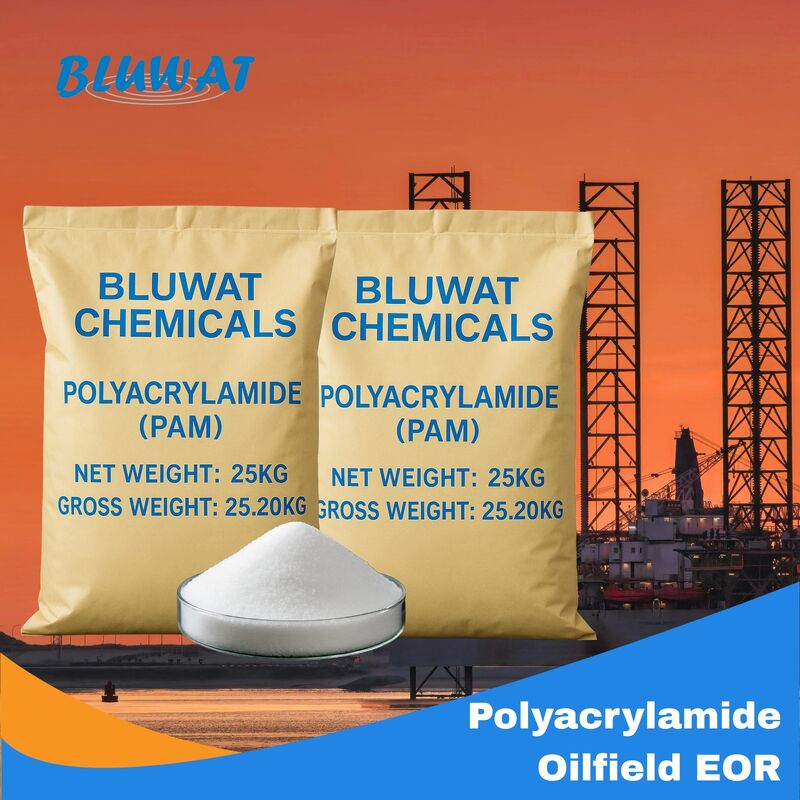
Product Role in Mature Waterfloods
In mature oilfields, long-term waterflooding often leads to channeling, early water breakthrough, and high water cuts. This HPAM polymer converts a standard waterflood into a polymer-flood style operation, improving the water–oil mobility ratio, stabilizing the displacement front, and reducing bypassed oil.
Key Benefits
- Improves mobility ratio by thickening injection water at low polymer dosage.
- Reduces channeling through high-permeability streaks and fractures.
- Enhances sweep efficiency in mature and heterogeneous reservoirs.
- Extends useful life of existing waterflood infrastructure.
- Offers a scalable, field-proven chemical upgrade to conventional operations.
Typical Application Scenarios
Depleted waterfloods with high WOR, where marginal oil zones remain under-swept.
Strong contrast in permeability, requiring mobility control for better vertical conformance.
Fields with existing water injection facilities seeking low-CAPEX incremental recovery.
Technical Characteristics
The polymer is supplied as a free-flowing granular powder with high molecular weight and designed ionic character to suit common injection waters.
| Parameter | Typical Range |
|---|---|
| Appearance | Off-white granular powder |
| Molecular Weight | 5–22 million (grade dependent) |
| Ionic Type | Anionic HPAM (other types available) |
| Solid Content | ≥ 89% |
| Residual Monomer | ≤ 0.05% |
| Particle Size | 20–100 mesh |
| Working Concentration | 0.05% – 0.5% w/w |
| pH (1% solution) | Approx. 6 – 8 |
| Packaging | 25 kg bags / 750 kg jumbo bags |
Design & Implementation
Successful mobility control requires integration of geological, reservoir, and surface-facility understanding. Typical engineering workflow includes:
- Screening candidate patterns and wells based on water cut and remaining oil saturation.
- Performing core floods and rheology tests with formation water.
- Defining slug size, polymer concentration, and injection strategy.
- Planning phased rollout: pilot pattern → extension → field-wide deployment.
Solution Preparation & Injection
HPAM must be hydrated under controlled shear to unlock full viscosity and avoid polymer damage.
Typical Working Concentration
For waterflood mobility control, solutions are commonly prepared between 0.05% and 0.3% by weight, adjusted according to reservoir permeability, salinity, and target viscosity.
Field Monitoring Guidelines
- Track injection pressure trends and pattern injectivity.
- Monitor water cut, WOR, and oil production response over time.
- Observe produced polymer levels where sampling is available.
- Adjust polymer concentration or slug size based on pilot results.