logo
Good price  online

products details

Created with Pixso. Home Created with Pixso. Products Created with Pixso.
Water Purifying Chemicals
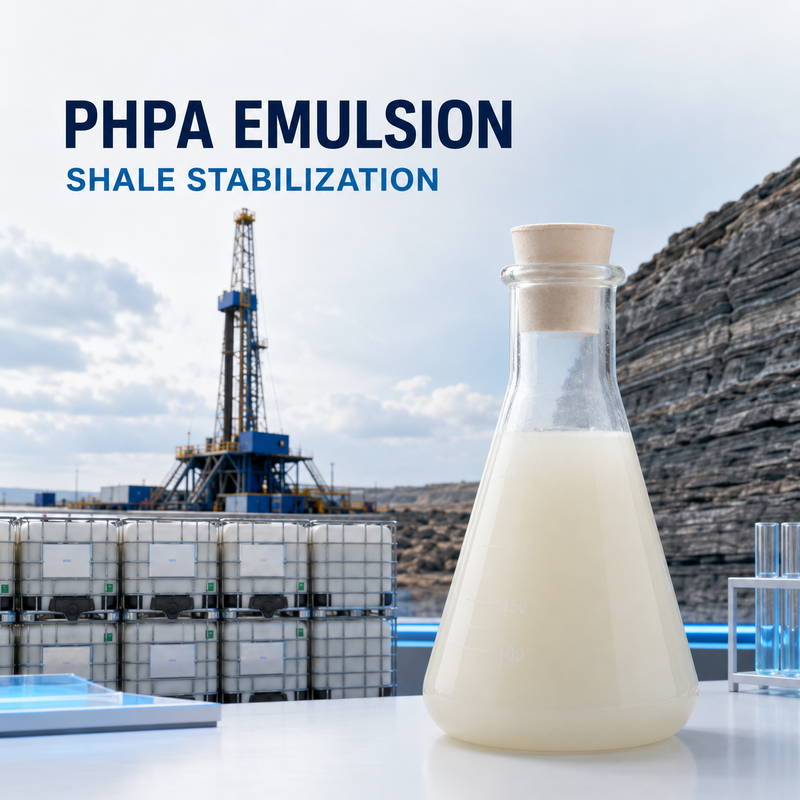
Created with Pixso. PHPA Emulsion for Water-Based Drilling Fluids and Shale Stabilization

PHPA Emulsion for Water-Based Drilling Fluids and Shale Stabilization

Brand Name: Bluwat
Model Number: EC8050 / EA5620
MOQ: 1 Ton
Price: negotiable
Delivery Time: 7-10 Working days
Payment Terms: L/C, D/A, D/P, T/T
Detail Information
Place of Origin:
China
Certification:
ISO
Molecular Weight:
Very High
Charge Degree:
High
Appearance:
Milky White
Solid Content:
38-40%
Bulk Density:
About 1.0
Specific Gravity At 25°C:
1.01-1.05
Shelf Life:
6 Months
Packaging:
1000 Kg IBC Drum
Packaging Details:
1000 kg IBC drum
Product Description
Blufloc PHPA Emulsion Series

PHPA Emulsion for Water-Based Drilling Fluids

Very-high-molecular-weight, high-charge EC8050 and EA5620 screening candidates for shale encapsulation, dispersion control, and low-gravity-solids management in water-based drilling systems.

EC8050 EA5620 38-40% Solid Content 1000 kg IBC

TDS Snapshot

  • Grades BLUFLOC EC8050 and EA5620
  • Form Milky-white emulsion
  • Profile Very-high molecular weight, high charge
  • Duty Water-based drilling-fluid screening
Product Introduction

Build a Balanced Inhibitory Fluid

Water-based drilling systems must limit shale dispersion without allowing polymer treatment to mask a separate mud-weight, hydraulics, pressure, or mechanical-stability problem. The priority is a balanced inhibitory fluid that preserves recognizable cuttings, controls low-gravity solids, and remains treatable as contamination changes.

BLUFLOC EC8050 and EA5620 are the two PHPA emulsion grades listed in the supplied family TDS. Both are shown as very-high-molecular-weight, high-charge, milky-white emulsions with 38-40% solid content.

Equal Screening Status

The supplied family TDS does not assign EC8050 and EA5620 different application roles. They should therefore enter screening as equal candidates rather than be positioned by an unsupported grade distinction.

Final selection must come from current grade documents, representative laboratory work, and a controlled field trial in the complete mud system.

Application Challenges

Inhibition, Solids Control, and Hole Condition Must Be Read Together

Polymer response is only one part of drilling-fluid performance. Formation behavior, solids loading, hydraulics, mud weight, and mechanical conditions must be evaluated at the same time.

01

Balanced Inhibition

Preserve recognizable cuttings and control low-gravity solids while keeping the fluid responsive to changing contamination.

02

Reactive Shale

Water contact can trigger hydration, dispersion, and disintegration that increase fines and weaken cuttings integrity.

03

Fine Drilled Solids

Accumulating fines raise low-gravity solids, change rheology, and increase dilution and solids-control demand.

04

Wellbore Instability

Enlargement, cavings, or unstable shaker cuttings may reflect chemical dispersion, mechanical instability, or both.

Encapsulation Mechanism

How the PHPA Emulsion Works

PHPA adsorbs at multiple points on shale and drilled solids. The polymer film and encapsulation can reduce dispersion and disintegration, while the long chain can influence low-shear rheology and solids behavior.

Function 1

Adsorb and Encapsulate

Multiple-point adsorption helps bind the surface of shale and drilled solids and can preserve cuttings integrity.

Function 2

Limit Dispersion

Reduced disintegration can lower the rate at which reactive cuttings become fine, difficult-to-remove solids.

System Role

Work with the Inhibition Package

In a KCl-PHPA mud, KCl and PHPA perform different but complementary roles; PHPA is not a substitute for the entire package.

Important selection note: EC8050 and EA5620 are screening candidates, not a fixed prescription. Final grade, preparation, dose, addition point, and acceptance criteria require representative laboratory and field trials. Molecular weight and charge class alone do not predict performance; ions, pH, temperature, solids, shear, aging, and the complete chemical package can change the observed result.
Grade Screening

Recommended BLUFLOC Candidates

Keep both TDS-listed emulsion grades in the initial comparison. Do not infer a grade-specific drilling role that the supplied family TDS does not state.

Grade Molecular Weight Charge Screening Position
EC8050 Very High High Screening candidate; no grade-specific application role stated
EA5620 Very High High Screening candidate; no grade-specific application role stated
Supplied Family TDS

TDS Specifications

TDS Item EC8050 EA5620
Product form Emulsion Emulsion
Molecular weight Very High Very High
Charge degree High High
Appearance Milky white Milky white
Solid content 38-40% 38-40%
Bulk density About 1.0 About 1.0
Specific gravity at 25°C 1.01-1.05 1.01-1.05
Shelf life 6 months 6 months
Packaging 1000 kg IBC drum 1000 kg IBC drum

TDS confirmation note: Exact active content, viscosity, specification limits, shelf life, and preparation instructions should be confirmed on the current grade-specific TDS and order specification.

Preparation-document warning: The supplied family TDS contains a general preparation section referring to a polymer eductor or dry-powder feeder. It does not provide a separate inversion or make-down procedure for EC8050 and EA5620 emulsions. Do not automatically apply powder preparation instructions to these emulsion grades. Obtain the current grade-specific emulsion procedure before commissioning.
Evaluation Advantages

Application Advantages to Verify in Testing

  • Potential fit for water-based drilling-fluid duty after representative testing
  • Very-high-molecular-weight PHPA emulsion format for liquid handling and metering
  • High-charge classification stated for EC8050 and EA5620 in the supplied TDS
  • PHPA-family compatibility claim covering biopolymers, PAC, and CMC, subject to formulation testing
  • Factory-direct documentation, sample screening, order coordination, and export support
Evaluation Workflow

Screen the Grade Inside the Complete Mud System

1

Characterize Formation and Baseline Mud

Record shale reactivity, salinity, hardness, pH, solids, temperature, and the initial fluid properties.

2

Screen Both Emulsion Grades

Compare EC8050 and EA5620 at several active-polymer doses without assuming different roles from the family TDS.

3

Measure Drilling-Fluid Performance

Compare hot-rolling recovery, cuttings integrity, dispersion, rheology, fluid loss, and lubricity against an untreated control.

4

Test the Complete Formulation

Repeat the preferred condition with actual KCl, PAC, CMC, biopolymer, weighting material, and expected contamination.

5

Run a Controlled Field Trial

Trend dilution, solids-control load, cavings, torque, drag, and mud properties before changing the treatment program.

Product Selection and Compatibility

Use Formation Response and Complete-Fluid Data

Select with shale-recovery and dispersion results together with full mud rheology, filtration, lubricity, and solids-control observations. A visually clean beaker is not sufficient evidence of borehole stability.

Compare the Total Operating Outcome

Neat-emulsion price per kilogram does not show the whole result.

  • Active content, make-down efficiency, and active-polymer dose
  • Equipment throughput and solids or fluid quality
  • Drilling performance, dilution, logistics, and downstream cost
  • Compatibility with KCl, PAC, CMC, biopolymer, weighting materials, and contamination
Operating Control

Indicators to Record

  • Hot-rolling shale recovery
  • Cuttings integrity and shaker loading
  • Low-gravity-solids trend
  • Rheology and fluid loss after aging
  • Cavings, dilution, and hole-condition observations
Troubleshooting

Do Not Use PHPA to Mask a Mechanical Problem

!

If Shale Recovery Is Good but Cavings Continue

Investigate in-situ stress, mud weight, equivalent circulating density, pressure balance, trajectory, hydraulics, natural fractures, and other mechanical causes before increasing PHPA.

Polymer treatment can support encapsulation and dispersion control, but it cannot correct an unsuitable pressure window or a mechanically unstable formation.

Supply Option

Packaging

1000 kg IBC Drum

The supplied family TDS specifies this packaging for the liquid products.

Safe Handling

Storage and Handling

Store in the original packaging in a cool, dry place away from heat, flame, and direct sunlight. The supplied TDS states a 6-month shelf life for the emulsion products.

Follow the current SDS for handling, spill control, personal protection, transport, and disposal. Polymer spills may create a severe slip hazard and require prompt containment and cleanup.

25+ Years Manufacturing experience since 2000
3 Bases Production, supply, and export support
Manufacturer Support

Why Choose Bluwat Chemicals

  • More than 25 years of water-treatment chemical manufacturing experience since 2000
  • Three production bases supporting factory-direct supply, batch coordination, and export planning
  • Export experience serving customers in more than 80 countries and regions
  • Screening support using customer drilling fluid, formation sample, brine, or produced-water conditions
  • TDS, SDS, COA, packing details, and available company-level certification documents for order review

For PHPA emulsion in water-based drilling fluids, Bluwat can review the target duty, compare the TDS-listed grades, prepare a screening plan, and define laboratory and field acceptance indicators with the customer.

Company-level certificates or management-system documents should not be represented as grade-specific application approvals unless the applicable certificate explicitly says so.

Technical Service

Quality Control and Technical Support

Specification Confirmation

Confirm the selected grade, current specification, order limits, and documentation before production.

Representative Grade Screening

Test EC8050 and EA5620 because the supplied family TDS does not assign them different application roles.

Controlled Laboratory Records

Record water chemistry, temperature, shear history, mixing sequence, and baseline fluid properties.

Evidence-Based Scale-Up

Scale up only after agreed indicators and operating limits are demonstrated under representative conditions.

Frequently Asked Questions

PHPA Emulsion for Drilling Fluids FAQ

Should the polymer be selected only by molecular weight?

No. The supplied TDS gives the same broad molecular-weight and charge class for both grades. Formation response and complete-fluid behavior must decide the selection.

Can field dilution be used as the only performance signal?

No. Dilution demand is affected by many variables and should be interpreted with solids, rheology, treatment history, and hole-condition data.

Does PHPA stop every type of shale instability?

No. PHPA can support encapsulation and dispersion control, but mechanical instability, pressure imbalance, fractured formations, and unsuitable mud weight require separate diagnosis.

Can PHPA replace KCl in a KCl-polymer mud?

Not automatically. KCl is used as a shale inhibitor in many PHPA mud designs, and the two materials should be evaluated as different parts of a complete formulation.

Representative Testing First

Confirm the Grade, Complete Mud System, and Field Acceptance Criteria Together

Screen EC8050 and EA5620 with the actual formation, brine, additives, solids, temperature, and shear history. Confirm the grade-specific emulsion preparation procedure before commissioning, then scale up only when laboratory and field indicators support the treatment program.