logo
Good price  online

products details

Created with Pixso. Home Created with Pixso. Products Created with Pixso.
Water Purifying Chemicals
Created with Pixso. Partially Hydrolyzed Polyacrylamide Emulsion for Reactive Shale Encapsulation

Partially Hydrolyzed Polyacrylamide Emulsion for Reactive Shale Encapsulation

Brand Name: Bluwat
Model Number: EC8050 / EA5620
MOQ: 1 Ton
Price: negotiable
Delivery Time: 7-10 Working days
Payment Terms: L/C, D/A, D/P, T/T
Detail Information
Place of Origin:
China
Certification:
ISO
Molecular Weight:
Very High
Charge Degree:
High
Appearance:
Milky White
Solid Content:
38-40%
Bulk Density:
About 1.0
Specific Gravity At 25°C:
1.01-1.05
Shelf Life:
6 Months
Packaging:
1000 Kg IBC Drum
Packaging Details:
1000 kg IBC drum
Product Description
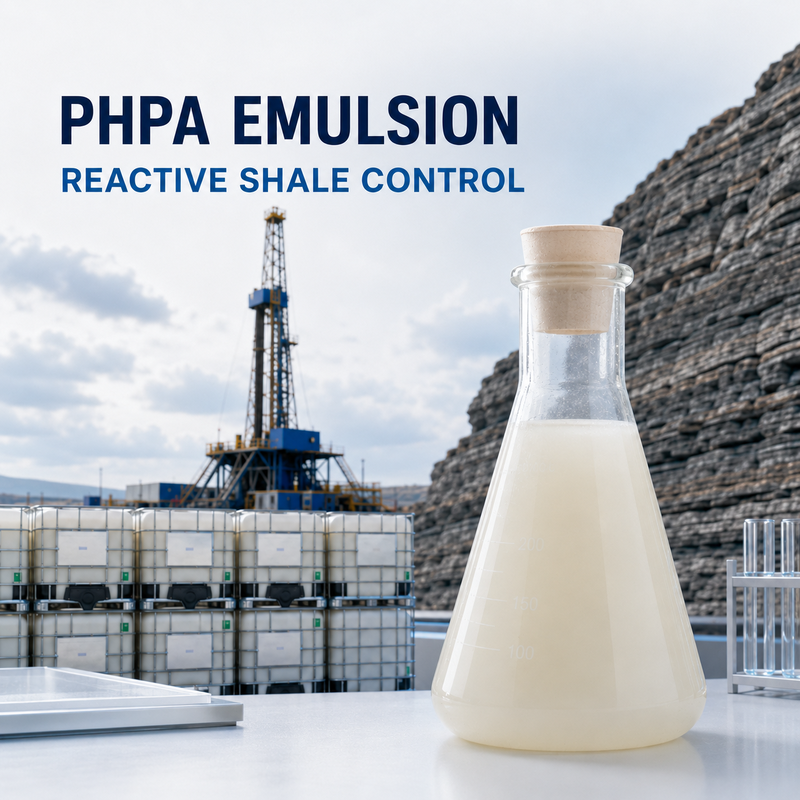
BLUFLOC PHPA Emulsion

PHPA Emulsion for Highly Dispersive Shale Control

Very-high-molecular-weight PHPA emulsion candidates for reactive shale screening, dispersion control, and water-based drilling-fluid evaluation.

EC8050 & EA5620
38-40% Solid Content
1000 kg IBC Drum
Representative Testing Required
01

Product Introduction


Highly dispersive shale can break into colloidal fines before conventional surface solids-control equipment can remove it.

The evaluation must distinguish reduced dispersion from simple viscosity increase and must check whether encapsulated solids can still be removed efficiently. BLUFLOC EC8050 and EA5620 are the two PHPA emulsion grades listed in the supplied family TDS. Both are shown as very-high-molecular-weight, high-charge, milky-white emulsions with 38-40% solid content. The TDS does not assign them different application roles, so final selection must come from current grade documents and representative testing.

02

Application Challenges

 
The evaluation must distinguish reduced dispersion from simple viscosity increase and must check whether encapsulated solids can still be removed efficiently.
Reactive shale that disperses after contact with the water phase
Fine drilled solids that accumulate and increase low-gravity solids
Wellbore enlargement, cavings, or unstable cuttings at the shakers
03

How the PHPA Emulsion Works


PHPA is used in water-based drilling fluids to adsorb at multiple points on shale and drilled solids. The resulting polymer film and encapsulation can reduce dispersion and disintegration while the long polymer chain also influences low-shear rheology and solids behavior. In a KCl-PHPA design, KCl and PHPA perform different but complementary roles, so the polymer should not be treated as a substitute for the entire inhibition package.

Very-high molecular weight provides long-chain reach, while the stated high charge describes the broad grade class. Neither description alone predicts field performance. Preparation quality, dissolved ions, pH, temperature, solids, shear, aging, and the complete chemical package can change the observed result.

Important Selection Note

The grades below are screening candidates, not a fixed prescription. Final selection, preparation, dose, addition point, and performance acceptance require representative laboratory and field or plant trials.

04

Recommended BLUFLOC Grade Screening

 
Grade Molecular Weight Charge Screening Position
EC8050 Very High High Screening candidate; no grade-specific application role stated
EA5620 Very High High Screening candidate; no grade-specific application role stated
05

TDS Specifications

 
TDS Item EC8050 EA5620
Product form Emulsion Emulsion
Molecular weight Very High Very High
Charge degree High High
Appearance Milky white Milky white
Solid content 38-40% 38-40%
Bulk density About 1.0 About 1.0
Specific gravity at 25°C 1.01-1.05 1.01-1.05
Shelf life 6 months 6 months
Packaging 1000 kg IBC drum 1000 kg IBC drum
TDS confirmation note: Exact active content, viscosity, specification limits, shelf life, and preparation instructions should be confirmed on the current grade-specific TDS and order specification.

The supplied family TDS contains a general preparation section that refers to a polymer eductor or dry-powder feeder. It does not provide a separate inversion or make-down procedure for EC8050 and EA5620 emulsions. Do not automatically apply powder preparation instructions to the emulsion grades; obtain the current grade-specific emulsion procedure before commissioning.

06

Application Advantages to Evaluate

 
  • Potential fit for the defined partially hydrolyzed polyacrylamide emulsion for reactive shale duty after representative testing
  • Very-high-molecular-weight PHPA emulsion format for liquid handling and metering
  • High-charge classification stated for both EC8050 and EA5620 in the supplied TDS
  • PHPA-family compatibility claim covering biopolymers, PAC, and CMC, subject to formulation testing
  • Factory-direct documentation, sample screening, order coordination, and export support
07

Recommended Evaluation and Dosing Workflow

 
  1. Characterize the formation and baseline mud, including shale reactivity, salinity, hardness, pH, solids, and temperature.
  2. Screen EC8050 and EA5620 at several active-polymer doses without assuming the two TDS-listed grades have different application roles.
  3. Compare hot-rolling recovery, cuttings integrity, dispersion, rheology, fluid loss, and lubricity against an untreated control.
  4. Repeat the preferred condition with the actual KCl, PAC, CMC, biopolymer, weighting material, and contamination expected in the field.
  5. Run a controlled field trial and trend dilution, solids-control load, cavings, torque, drag, and mud properties before changing the treatment program.
08

Product Selection and Compatibility


Representative Fluid Screening

Compare size distribution, turbidity, recovery, and rheology after controlled shale exposure. Include the actual brine and inhibitor package because encapsulation performance is water-chemistry dependent.

Total Operating Outcome

Compare candidates on active-polymer mass and total operating outcome. Neat-emulsion price per kilogram can be misleading when active content, make-down efficiency, dose, equipment throughput, solids or fluid quality, drilling performance, logistics, and downstream costs differ.

09

Operating Indicators to Record

 
Shale dispersion and recovered mass
Particle-size distribution
Screen conveyance and blinding
Plastic viscosity and low-shear behavior
Dilution volume per drilled interval
!
Troubleshooting Note

If performance drifts: If treated cuttings become sticky or screens blind, review dose, preparation, addition point, dilution, and the interaction with clay and other polymers.

10

Packaging, Storage, and Safe Handling


The supplied TDS specifies 1000 kg IBC drum packaging for liquid products. Store the product in its original packaging in a cool, dry place away from sources of heat, flame, and direct sunlight. The stated shelf life for the emulsion products is 6 months. Follow the current SDS for handling, spill control, personal protection, transport classification, and disposal. Polymer spills may create a severe slip hazard and should be contained and cleaned promptly.

11

Why Choose Bluwat Chemicals

 
  • More than 25 years of water-treatment chemical manufacturing experience since 2000.
  • Three production bases supporting factory-direct supply, batch coordination, and export planning.
  • Export experience serving customers in more than 80 countries and regions.
  • Technical screening support based on the customer's drilling fluid, formation sample, brine, or produced-water conditions.
  • TDS, SDS, COA, packing details, and available company-level certification documents can be supplied for order review.

For partially hydrolyzed polyacrylamide emulsion for reactive shale, Bluwat can review the target duty, prepare a screening plan, compare the TDS-listed emulsion grades, and define laboratory and field acceptance indicators with the customer. Company-level certificates or management-system documents should not be represented as grade-specific application approvals unless the applicable certificate explicitly says so.

12

Quality Control and Technical Support

 
  • Confirm the selected grade, current specification, order limits, and documentation before production.
  • Screen EC8050 and EA5620 with representative fluids because the supplied family TDS does not assign different application roles to the two grades.
  • Record water chemistry, temperature, shear history, mixing sequence, and baseline fluid properties during laboratory work.
  • Scale up only after agreed performance indicators and operating limits are demonstrated under representative conditions.
13

Frequently Asked Questions

 
What does encapsulation mean in this application?
It refers to polymer adsorption around shale or cuttings that can retard dispersion and disintegration; it does not mean the formation becomes impermeable.
Is more polymer always better for encapsulation?
No. Overtreatment can increase viscosity, bind fines, or impair solids removal.
Does PHPA stop every type of shale instability?
No. It can support encapsulation and dispersion control, but mechanical instability, pressure imbalance, fractured formations, and unsuitable mud weight require separate diagnosis.
Can PHPA replace KCl in a KCl-polymer mud?
Not automatically. Industry references describe KCl as a shale inhibitor in many PHPA mud designs; the two materials should be evaluated as parts of a complete formulation.

Screen the Right PHPA Emulsion for Your Drilling Fluid

Share your baseline mud properties, formation sample, water chemistry, temperature, and target performance indicators with Bluwat to prepare a representative EC8050 and EA5620 screening plan.