| Brand Name: | BLUWAT |
| Model Number: | Blufloc Emulsion |
| MOQ: | 1000kgs |
| Price: | negotiable |
| Delivery Time: | 5-10days |
Bridge fibers, fines, mineral fillers, coating pigments, and coagulated solids with water-based EWA 7520 and oil-based EA 6520 screening options.
Paper mill wastewater may contain fibers, fines, calcium carbonate, clay, starch, latex, dyes, and biological solids. Furnish and coating changes can alter surface charge within hours and change the preferred polymer dose.
Anionic PAM is commonly applied after charge neutralization by PAC, alum, ferric salt, or an organic coagulant. Its performance must be coordinated with chemical recovery, DAF, clarifier, and sludge-handling objectives.
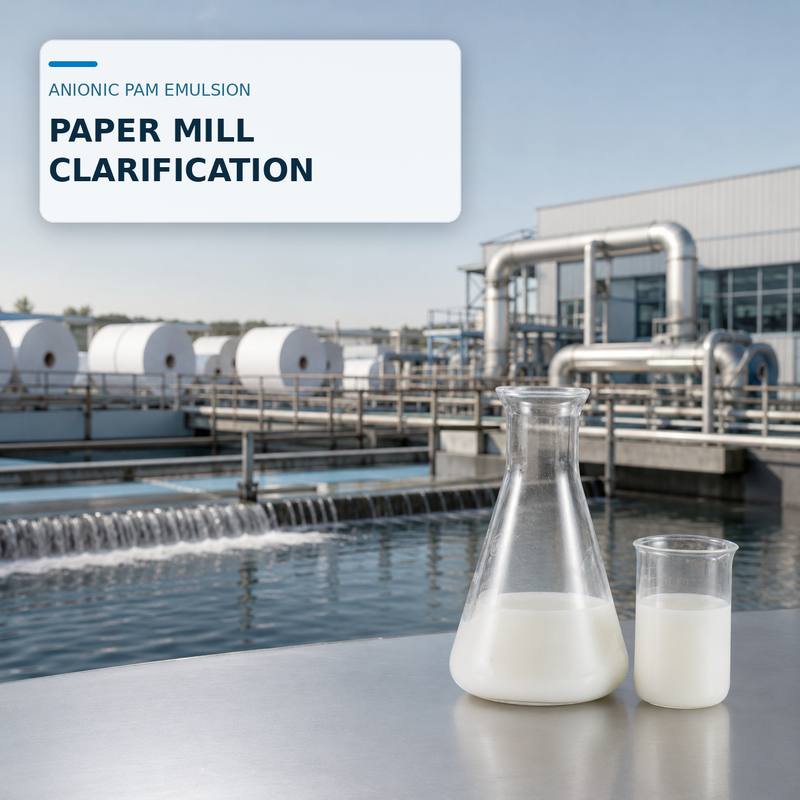
Blufloc anionic PAM emulsion bridges fibers, fillers, coating pigments, and coagulant floc for faster clarification and stronger fine-solids capture.
EWA 7520 and EA 6520 support continuous liquid dosing across changing paper grades when charge neutralization, preparation, addition point, and mixing are controlled.
Paper grade, furnish, filler loading, coating chemistry, broke handling, wet-end additives, and upstream coagulant dose can change wastewater charge and floc strength during the same shift.
Short fibers, calcium carbonate, clay, and pigment fines may escape capture and raise clarified-water TSS.
Grade changes and wet-end chemicals can alter the charge balance established by the primary coagulant.
Excessive mixing, transfer shear, or unsuitable addition points can break floc before DAF or clarification.
Poor solids capture can increase return-water turbidity and affect reuse, shower systems, or downstream treatment.
After coagulant destabilization, very-high-molecular-weight APAM adsorbs onto fibers and mineral fines and links multiple particles into larger floc. The coagulant controls primary charge, while the long polymer chain provides bridging for sedimentation or flotation.
Establish a consistent PAC, alum, ferric salt, or organic-coagulant condition before comparing APAM grades.
Activated APAM connects destabilized fibers, fillers, pigments, and biological solids into larger floc.
Preserve floc through DAF or clarifier mixing to improve capture, water clarity, and sludge handling.
Compare candidates at equal active polymer mass using actual mill wastewater and the current paper grade, furnish, ash, pH, conductivity, coagulant, solids loading, temperature, and shear.
| Grade | Base | Molecular Weight | Charge | Suggested Screening Role |
|---|---|---|---|---|
| EWA 7520 | Water-based | Very High | Medium anionic | Water-based starting candidate for automatic mill dosing |
| EA 6520 | Oil-based | Very High | High anionic | High-anionic comparator for difficult fines and fillers |
The product pages classify the cationic EC and EWC series as high molecular weight and the anionic EA and EWA grades as very high molecular weight. Confirm exact commercial specification limits, active content, viscosity, shelf life, and preparation instructions on the current grade-specific TDS and order specification.
Document paper grade, furnish, ash, pH, conductivity, coating condition, wet-end chemistry, and the current coagulant.
Confirm consistent charge neutralization before APAM screening so coagulant drift does not distort the comparison.
Test grade, active dose, dilution, addition point, shear, and realistic DAF flotation or clarification conditions.
Record capture, clarified-water TSS, fiber and ash loss, separation rate, sludge volume, and downstream dewatering.
Create separate control ranges for major paper-grade families, furnish changes, coated grades, and high-broke conditions if needed.
EWA 7520 is a practical water-based candidate for continuous automatic dosing. EA 6520 should be compared when filler-rich wastewater or difficult fines require higher anionic charge and strong bridging.
Select the preferred grade with the actual charge-neutralization program. If paper grade, wet-end retention chemistry, coating color, or broke handling changes significantly, confirm the dose band or re-screen.
Neat-emulsion price per kilogram can be misleading. Compare active polymer mass together with preparation efficiency, dose, equipment throughput, water quality, sludge volume, dewatering, recovered-material value, and disposal cost.
If performance changes with furnish or grade, inspect wet-end retention chemicals, coating returns, broke handling, ash loading, pH, conductivity, and the primary coagulant as well as the effluent treatment plant.
Overdosing coagulant can change the preferred APAM charge and increase sludge. If floc forms but breaks before separation, review polymer dilution, addition point, mixing intensity, transfer shear, and DAF or clarifier hydraulics before increasing dose.
Keep the package sealed in a cool, dry, ventilated area. Protect it from direct sunlight, freezing, and excessive heat.
Follow the grade-specific TDS and SDS for shelf life, handling limits, and transport classification. Polymer spills can make floors extremely slippery and should be contained and cleaned promptly.
For paper mill effluent clarification after coagulation, Bluwat can screen adjacent PAM emulsion grades, review preparation and dosing conditions, and help define a plant-trial plan using agreed water, capture, sludge, and cost indicators.
Confirm the required grade specification and order documentation before production and shipment.
Shortlist products under realistic pH, temperature, solids, furnish, ash, water chemistry, coagulant, and shear.
Supply clear make-down, dilution, dosing, addition-point, mixing, separation, and scale-up recommendations.
Adjust charge level, dose, addition point, dilution, or mixing when paper grade or process conditions change.
It can improve fiber and fine-solids capture. Whether the recovered material can return to production depends on its cleanliness, furnish compatibility, and paper-quality requirements.
The coagulant reduces charge and destabilizes fine material. APAM then uses long-chain bridging to form larger floc for flotation or sedimentation.
Yes. Pigments, latex, binders, dispersants, and filler loading can change charge and solids composition, so coated-grade wastewater should be tested separately when necessary.
Possibly, but the dominant solids, surface charge, treatment objective, and required dose may differ. Separate screening is recommended before using one grade for both duties.
Screen EWA 7520 and EA 6520 with representative paper mill wastewater after stabilizing the primary coagulant. Confirm the preferred grade using clarified-water TSS, fiber and ash capture, DAF or settling rate, sludge volume, downstream dewatering, preparation efficiency, and total chemical cost across the mill's major grade families.