| Brand Name: | BLUWAT |
| Model Number: | Blufloc Emulsion |
| MOQ: | 1000kgs |
| Price: | negotiable |
| Delivery Time: | 5-10days |
Screen EWA 7520 and EA 6520 for rapid aggregation of precipitated impurities and clarification mud after liming, heating, and clarification chemistry, subject to product-specific regulatory and food-contact documentation.
Sugar clarification must remove suspended and precipitated impurities while protecting sucrose recovery, color, filtration, and food safety. Juice composition changes with cane or beet quality, harvest, soil, weather, extraction, and process control.
Application testing must therefore include sugar-quality and residual-control requirements, not settling alone. Only a grade supported by documentation suitable for the intended process, customer, and destination market should be considered.
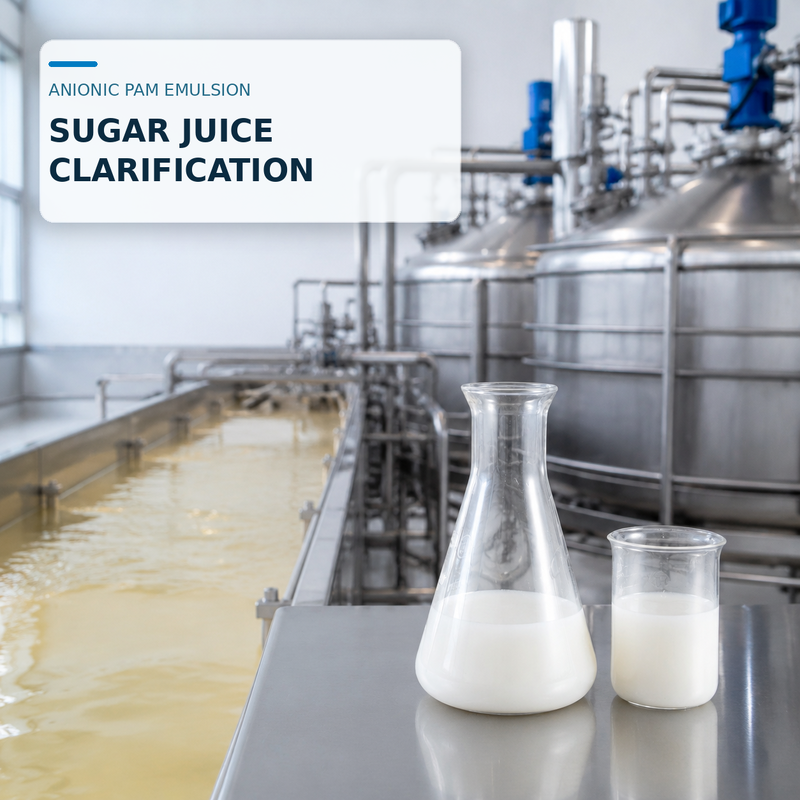
Blufloc anionic PAM emulsion promotes rapid aggregation of precipitated impurities and mud after liming, heating, and clarification chemistry.
EWA 7520 and EA 6520 are screening candidates only. Final grade selection requires fresh process-juice trials, formal quality review, and confirmation of all applicable food-contact and regulatory documents.
A polymer program must remain stable across the crushing campaign while respecting the mill's clarification route, sugar-quality targets, residual limits, and documentation controls.
Fine precipitated impurities can settle slowly, raise clarified-juice turbidity, and increase mud carryover.
Cane or beet quality, soil, harvest timing, weather, and extraction conditions can change juice behavior during production.
Lime, phosphate, sulfitation, carbonation, temperature, pH, and residence time affect precipitate and polymer response.
Food-contact, residual, customer, traceability, and destination-market requirements must be confirmed before trials and supply.
After the clarification process forms precipitated impurities, very-high-molecular-weight APAM bridges fine mud particles into larger settleable floc. Controlled distribution and gentle mixing help protect floc and support a compact mud layer.
Complete the actual liming, heating, phosphate, sulfitation, carbonation, or other clarification chemistry first.
Apply the selected dilution uniformly so polymer chains contact fine precipitated impurities without localized overdosing.
Use gentle representative mixing, then evaluate settling, clarified juice, mud compaction, filtration, color, and sugar recovery.
Compare candidates at equal active polymer mass using fresh process juice after the mill's actual precipitation steps and at representative temperature, pH, solids, mixing, and residence time.
| Grade | Base | Molecular Weight | Charge | Suggested Screening Role |
|---|---|---|---|---|
| EWA 7520 | Water-based | Very High | Medium anionic | Potential water-based screening grade, subject to documentation approval |
| EA 6520 | Oil-based | Very High | High anionic | Technical comparator, subject to process and regulatory approval |
The product pages classify the cationic EC and EWC series as high molecular weight and the anionic EA and EWA grades as very high molecular weight. Confirm exact commercial specification limits, active content, viscosity, shelf life, preparation instructions, and supporting documents on the current grade-specific TDS and order specification.
Define the regulatory, food-contact, residual, customer, traceability, and destination-market documents required before trials.
Collect representative juice after the actual liming, heating, and precipitation steps; preserve its temperature and fresh precipitate behavior.
Screen dose, dilution, addition point, mixing, temperature, and residence time under conditions representative of the operating clarifier.
Evaluate settling, clarified-juice turbidity and color, mud volume, filtration, residual controls, and sucrose loss together.
Validate performance across representative feed changes with formal approval from production, quality, regulatory, and customer-facing teams.
EWA 7520 may be screened where a water-based, medium-anionic emulsion suits the process, but it must not be described as food-approved without current product-specific documentation. EA 6520 is a higher-anionic technical comparator and is subject to the same process, regulatory, quality, and customer review.
Re-screen when cane or beet quality, clarification route, lime or phosphate dose, sulfitation or carbonation conditions, temperature, pH, throughput, or quality targets change materially.
Neat-emulsion price per kilogram can be misleading. Compare active polymer mass with preparation efficiency, dose, clarifier throughput, mud volume, filtration, sugar recovery, quality compliance, and disposal cost.
If settling improves but juice color, filtration, mud losses, residual control, or sucrose loss worsens, the program is not optimized. Recheck upstream clarification chemistry, temperature, pH, precipitation, dose, dilution, addition point, and mixing.
Fresh hot juice and newly formed precipitate can behave differently from stored or cooled samples. Repeat testing with representative campaign material before changing the plant dose.
Keep the package sealed in a cool, dry, ventilated area. Protect it from direct sunlight, freezing, and excessive heat.
Follow the grade-specific TDS and SDS for shelf life, handling limits, and transport classification. Polymer spills can make floors extremely slippery and should be contained and cleaned promptly.
For raw sugar juice mud settling and clarification, Bluwat can screen adjacent PAM emulsion grades, review preparation and dosing conditions, and help define a plant-trial plan using agreed performance, sugar-quality, residual-control, and compliance indicators.
Confirm the required grade specification, food-contact or regulatory evidence, residual controls, and order documents before production and shipment.
Shortlist candidates with fresh process juice under realistic pH, temperature, precipitation, solids, water chemistry, mixing, and shear.
Supply clear make-down, dilution, dosing, addition-point, mixing, and scale-up recommendations for the selected grade.
Adjust charge level, dose, addition point, or mixing using settling, juice quality, mud, filtration, sucrose, and compliance data.
No. Product-specific regulatory and food-contact documentation must be confirmed for the intended country, process, customer, dose, and residual-control requirements.
It is generally evaluated after clarification precipitate has formed. The exact addition point, dilution, mixing, and residence time must be established through process trials.
No. Clarified-juice quality, color, mud losses, filtration, residual controls, and sucrose recovery must also be measured before a program is accepted.
Temperature and fresh precipitate behavior strongly influence polymer adsorption, flocculation, settling, mud compaction, and clarified-juice quality.
Screen EWA 7520 and EA 6520 only after confirming the intended process and documentation requirements. Select the grade, active dose, dilution, addition point, and mixing conditions using settling, clarified-juice quality, mud behavior, filtration, sucrose recovery, residual controls, formal quality approval, and total operating cost.