


 english
 français
 Deutsch
 Italiano
 Русский
 Español
 português
 Nederlandse
 ελληνικά
 日本語
日本語
 한국
한국
 العربية
 हिन्दी
 Türkçe
 indonesia
 tiếng Việt
 ไทย
ไทย
 বাংলা
বাংলা
 فارسی
فارسی
 polski

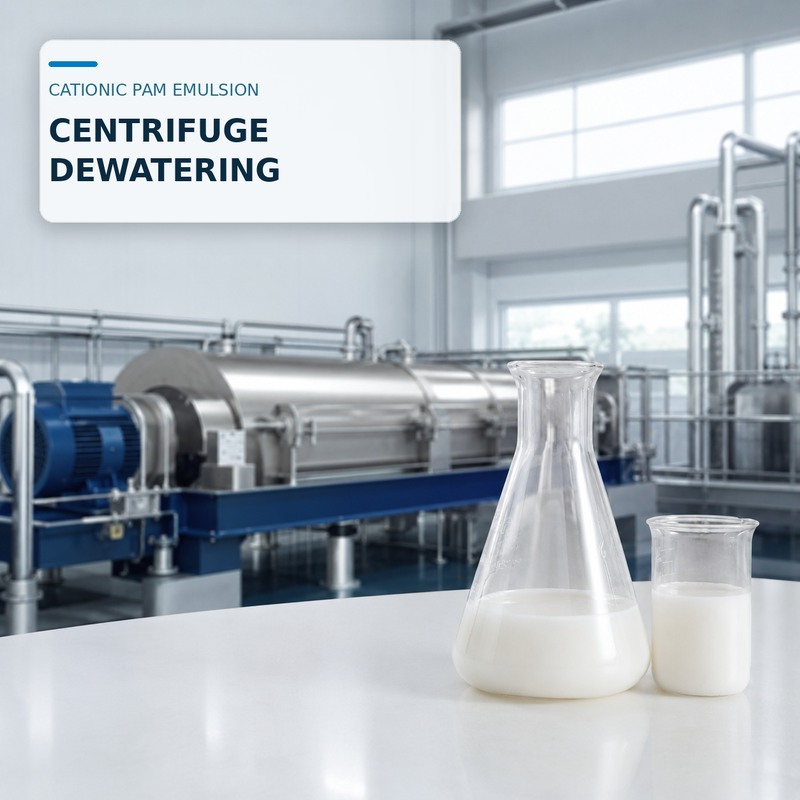
Cationic PAM Emulsion for Centrifuge Sludge Dewatering
High-molecular-weight liquid polymer grades designed to form fast, shear-resistant flocs for clearer centrate, stable torque, improved solids capture, and efficient centrifuge operation.
Polymer Conditioning Designed for Centrifuge Shear
A centrifuge exposes conditioned sludge to acceleration and high local shear. Large flocs that look excellent in a low-shear jar test may fragment at the feed zone, releasing fine solids into the centrate.
The correct polymer must develop quickly, tolerate the actual dilution water, and retain enough structure through the feed pipe and centrifuge bowl. Polymer selection should therefore reflect centrifuge-specific operating conditions rather than treating every dewatering machine as equivalent.
Fast and Shear-Resistant Floc Formation
Cationic PAM emulsion helps activated sludge form resilient flocs before entering the centrifuge bowl.
Blufloc grades can be screened by charge level to balance centrate clarity, cake dryness, equipment throughput, torque stability, and total polymer cost.
Common Problems in Centrifuge Sludge Dewatering
A polymer problem may appear as cloudy centrate, unstable torque, rising dosage, or inconsistent machine performance.
Floc Breakage
Conditioned flocs may break between the polymer injection point and the centrifuge bowl.
Rising Centrate Solids
Centrate TSS may increase when bowl speed, pond depth, or differential speed changes.
Torque Instability
Variable feed sludge and inconsistent conditioning can produce frequent torque fluctuations.
Excessive Polymer Dose
Poor emulsion inversion, unsuitable dilution water, or insufficient contact time can increase consumption.
How the Cationic PAM Emulsion Works
Centrifuge conditioning requires a balance between rapid charge neutralization, particle bridging, and resistance to mechanical shear.
Charge Reduction
Cationic sites reduce electrostatic repulsion between negatively charged activated-sludge particles.
Polymer Bridging
The high-molecular-weight backbone connects fine particles and forms larger solids aggregates.
Floc Retention
A correctly selected polymer produces compact flocs that form quickly and retain sufficient structure during transport and acceleration.
Recommended Blufloc Screening Grades
Screen adjacent charge levels under the same sludge, dilution-water, preparation, and centrifuge operating conditions.
| Grade | Base | Molecular Weight | Charge | Suggested Screening Role |
|---|---|---|---|---|
| EC 8050 | Oil-based | High | High | Primary starting point for many activated-sludge centrifuge trials. |
| EC 8060 | Oil-based | High | Very high | Candidate for high organic content or increased sludge charge demand. |
| EWC 8060 | Water-based | High | Very high | Water-based candidate for compatible preparation and dosing skids. |
Performance Benefits for Centrifuge Operations
Fast Conditioning
Supports rapid floc development before the sludge reaches the centrifuge feed zone.
Multiple Charge Options
Adjacent grades can be screened for different sludge compositions and charge demands.
Continuous Liquid Dosing
Pumpable emulsion form is suitable for compatible automatic make-down and metering systems.
Improved Centrate Clarity
Correct grade selection can improve fine-solids capture and reduce centrate TSS.
Stable Machine Operation
Consistent conditioning can support steadier torque and more predictable throughput.
Controlled Centrifuge Trial Procedure
Verify Polymer Preparation
Confirm that the emulsion make-down unit is producing a uniform, fully activated solution before changing the centrifuge settings.
Select the Injection Point
Choose a location that provides sufficient distribution and contact while limiting exposure to high-shear pumps, restrictive valves, or excessive pipeline shear.
Run Controlled Dose Steps
Adjust the polymer dose in controlled steps while maintaining stable sludge flow and feed-solids concentration.
Wait for a New Steady State
Allow the old conditioned sludge to clear and the bowl inventory to reach a new steady state before recording each result.
Optimize Polymer and Machine Together
Evaluate polymer dose together with bowl speed, pond depth, differential speed, torque, throughput, cake solids, and centrate TSS.
Product Selection Guidance
Use EC 8050 as a practical first screening grade for activated sludge centrifuge dewatering.
Compare EC 8060 when centrate solids capture remains weak at a technically reasonable dose.
EWC 8060 may be considered where the preparation skid and site handling policy favor a water-based carrier system.
Compare Active Polymer Mass and Total Cost
Neat-emulsion price per kilogram can be misleading when products differ in active content, preparation efficiency, working dose, and make-down performance.
The comparison should also include equipment throughput, cake dryness, centrate clarity, torque stability, operator adjustment, and downstream sludge-disposal cost.
Operating Indicators to Record
A Sudden Loss of Capture May Not Be a Polymer Problem
Confirm the sludge feed-solids concentration, feed flow, flowmeter accuracy, polymer-pump calibration, make-down quality, bowl conditions, differential-speed control, and solids-discharge operation before increasing the polymer dose.
When only the polymer dosage is changed, allow sufficient time for the previously conditioned sludge to clear the centrifuge and for the bowl inventory to reach a new steady state.
Packaging
Storage and Handling
- Keep the original package tightly sealed.
- Store in a cool, dry, and ventilated area.
- Protect the emulsion from direct sunlight.
- Prevent freezing and exposure to excessive heat.
- Follow the grade-specific TDS and SDS for shelf life, storage limits, handling, and transport classification.
- Contain and clean spills promptly because wet polymer can make floors extremely slippery.
Why Choose Bluwat Chemicals
- More than 25 years of water-treatment chemical manufacturing experience.
- Three modern production plants supporting stable production and export supply.
- More than 800,000 tons delivered and exports to over 100 countries and regions, according to the company website.
- Factory-direct coordination for grade selection, batch documentation, packaging, and export logistics.
- Laboratory screening support using representative customer sludge or water samples.
- Recommendations developed according to the actual centrate, cake, throughput, and operating-cost objectives.
- TDS, SDS, COA, and applicable certification documents available for the selected grade and destination market.
Quality Control and Technical Support
Specification Confirmation
Confirm the required commercial specification and order documentation before production and shipment.
Representative Screening
Shortlist products under realistic pH, temperature, solids, dilution-water chemistry, and shear conditions.
Preparation Recommendation
Provide make-down, dilution, dosing, injection, and scale-up recommendations for the selected grade.
Machine-Trial Review
Review plant data and adjust charge level, dose, injection point, mixing, or centrifuge operating conditions.
Centrifuge Dewatering PAM Emulsion FAQ
Where should CPAM be injected for a centrifuge?
The best injection point provides rapid polymer distribution and sufficient contact time without exposing the conditioned sludge to severe downstream shear. The final position should be confirmed during a controlled machine trial.
Why is the jar-test winner not always the centrifuge winner?
Conventional jar tests normally apply lower shear than a full-scale centrifuge. Centrifuge applications reward polymers that form flocs quickly and maintain sufficient floc integrity through pumping, transport, and acceleration.
Should the highest-charge grade be tested first?
Not necessarily. Start with a technically reasonable range of adjacent charge levels and compare centrate solids capture, cake dryness, throughput, torque, and active polymer cost per dry ton.
Can polymer reduce centrifuge torque fluctuations?
Better sludge conditioning can help stabilize solids behavior and support steadier torque. However, feed variability, bowl conditions, differential speed, pond depth, and mechanical operation must also be controlled.