


 english
 français
 Deutsch
 Italiano
 Русский
 Español
 português
 Nederlandse
 ελληνικά
 日本語
日本語
 한국
한국
 العربية
 हिन्दी
 Türkçe
 indonesia
 tiếng Việt
 ไทย
ไทย
 বাংলা
বাংলা
 فارسی
فارسی
 polski

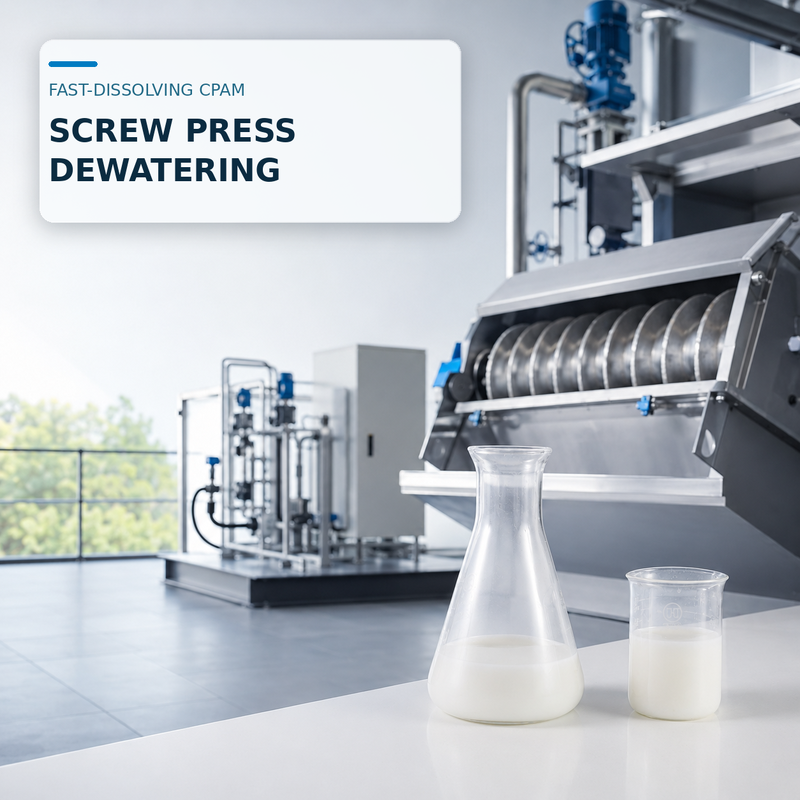
Fast-Dissolving Cationic PAM Emulsion for Automatic Screw Press Sludge Dewatering
High-molecular-weight liquid polymer grades designed to support stable floc formation, improved screen capture, clearer filtrate, consistent cake discharge, and compact automatic screw press operation.
Stable Floc for Gradual Screw Press Compression
Screw presses usually operate at lower shear than centrifuges but depend on stable floc entering a gradually narrowing dewatering zone. Poor conditioning allows fines to pass through screen gaps and can cause wet cake, cloudy filtrate, or unstable discharge.
Sites often select screw presses for low operator attention, so the polymer program must also be easy to prepare, pump, and verify. A liquid emulsion can fit compact automated skids when inversion, dilution, mixing, and feed calibration are correctly designed.
Fast-Dissolving CPAM for Automatic Systems
Fast-dissolving cationic polyacrylamide emulsion supports automatic screw press dewatering where compact equipment and repeatable floc formation are priorities.
Blufloc oil-based EC and water-based EWC options can be screened according to sludge charge demand, preparation layout, site handling policy, and the required dewatering result.
Common Screw Press Dewatering Problems
Polymer performance must be evaluated across the complete conditioning and dewatering system rather than by floc appearance alone.
Fine Solids Loss
Small or weak floc passes through the screen gaps and recycles solids to the upstream treatment process.
Wet Cake
Incomplete water release increases cake moisture and may raise transport or downstream disposal cost.
Floc Breakup
Excessive pump shear, recirculation, or flocculator speed can destroy conditioned floc before it reaches the screen.
Unstable Preparation
Variable water flow, incomplete activation, or poor pump calibration creates inconsistent results in compact dosing skids.
How the PAM Emulsion Works
Cationic PAM destabilizes negatively charged sludge particles and creates screen-retainable floc with controlled water release under gradual compression.
Charge Destabilization
Cationic sites reduce electrostatic repulsion between negatively charged biological or food-processing sludge particles.
Particle Bridging
High-molecular-weight polymer chains connect fine particles and form floc large enough to be retained by the screw press screen.
Controlled Water Release
Open, stable floc releases water as the screw gradually compresses the sludge through the narrowing dewatering zone.
Recommended Blufloc Screening Grades
Compare candidate grades under identical sludge, dilution-water, activation, mixing, feed-solids, and screw press conditions.
| Grade | Base | Molecular Weight | Charge | Suggested Screening Role |
|---|---|---|---|---|
| EWC 8040 | Water-based | High | High | Convenient starting grade for water-based automatic make-down and dosing systems. |
| EC 8050 | Oil-based | High | High | General-purpose starting candidate for biological sludge dewatering. |
| EWC 8060 | Water-based | High | Very high | Candidate for higher organic loading or stronger sludge charge demand. |
Benefits for Automatic Screw Press Systems
Rapid Activation
Liquid emulsion form supports compact and correctly designed automatic inversion and dilution systems.
Controlled Liquid Feeding
Pumpable liquid polymer enables stable metering when emulsion and dilution-water pumps are properly calibrated.
Flexible Charge Range
High and very-high-charge options can be screened for municipal, biological, and food-processing sludge.
Improved Screen Capture
Correct conditioning can reduce fine solids loss and support clearer filtrate and more stable cake formation.
Lower Routine Attention
A commissioned and documented dosing window can reduce frequent operator adjustment during normal operation.
Controlled Screw Press Trial Procedure
Stabilize Dilution Water
Confirm that dilution-water flow, pressure, quality, and temperature remain stable across the complete dosing range.
Activate the Selected Emulsion
Invert, dilute, mix, and age the emulsion according to the current grade-specific instructions. Avoid direct neat-product contact with the sludge.
Inject Before the Flocculation Chamber
Select an addition point that permits rapid distribution followed by gentle floc development before the conditioned sludge reaches the screen.
Adjust the Dose Gradually
Observe filtrate clarity, discharge texture, screen capture, and motor load while changing the polymer dose in small, controlled steps.
Define Operating Windows
Record practical preparation and dosing settings for low, normal, and high feed-solids conditions after the selected grade is confirmed.
Product Selection Guidance
EC 8050 or EWC 8040 is a practical starting point for typical biological sludge treated by an automatic screw press.
Compare EWC 8060 when screen capture remains poor because of higher organic loading or stronger cationic charge demand.
Confirm that the site's inversion, make-down, dilution, storage, and metering equipment is compatible with the selected oil-based or water-based carrier system.
Compare Active Polymer Mass and Total Operating Cost
Neat-emulsion price per kilogram can be misleading when products differ in active content, activation efficiency, preparation loss, working dose, and equipment throughput.
The comparison should also include cake solids, filtrate quality, screen capture, motor load, polymer consumption, operator adjustment, and downstream sludge handling or disposal cost.
Operating Indicators to Record
Check Preparation, Pumping, and Mixing Before Increasing the Dose
If visible floc disappears inside the press, inspect the sludge feed pump, recirculation path, flocculator speed, and distance between polymer injection and the screen.
If clean filtrate is accompanied by sticky cake, screen smearing, or higher polymer consumption without better dryness, overdosing is likely. Reduce the dose gradually and compare an adjacent charge grade if necessary.
Calibration checks for both the emulsion pump and dilution-water pump should be included in routine maintenance. Also verify screen condition, wash operation, sludge feed solids, and screw press loading before attributing instability entirely to the polymer.
Packaging
Storage and Handling
- Keep the original package tightly sealed.
- Store in a cool, dry, and ventilated area.
- Protect the emulsion from direct sunlight.
- Prevent freezing and exposure to excessive heat.
- Follow the grade-specific TDS and SDS for shelf life, handling limits, storage, and transport classification.
- Contain and clean spills promptly because wet polymer can make floors extremely slippery.
Why Choose Bluwat Chemicals
- More than 25 years of water-treatment chemical manufacturing experience supported by three modern production plants.
- More than 800,000 tons delivered and exports to over 100 countries and regions, according to the company website.
- Factory-direct coordination for grade selection, batch documentation, packaging, and export logistics.
- Laboratory screening support using representative customer sludge or wastewater samples.
- Recommendations developed according to actual screen capture, cake, filtrate, throughput, and operating-cost objectives.
- TDS, SDS, COA, and applicable certification documents available for the selected grade and destination market.
Quality Control and Technical Support
Specification Confirmation
Confirm the required commercial grade specification and order documentation before production and shipment.
Representative Sample Screening
Shortlist products under realistic pH, temperature, solids, dilution-water chemistry, and shear conditions.
Preparation Recommendation
Provide make-down, inversion, dilution, dosing, injection, and scale-up guidance for the selected grade.
Plant-Trial Review
Review trial data and adjust charge level, dose, addition point, mixing conditions, screw speed, or press loading.
Screw Press PAM Emulsion FAQ
Is PAM emulsion suitable for small automatic screw presses?
Yes, provided the dosing skid can correctly invert, dilute, mix, age, and meter the selected emulsion across the required operating range.
Can the emulsion be dosed neat?
Normally the emulsion should be properly inverted, diluted, and activated before contact with the sludge. Follow the current grade-specific TDS and preparation instructions.
What indicates polymer overdosing on a screw press?
Sticky floc, smeared screens, gelatinous filtrate, unstable cake discharge, or higher polymer consumption without better cake dryness can indicate excessive dosage.
Should a water-based or oil-based emulsion be selected?
Select the carrier system according to sludge performance, preparation-equipment compatibility, site handling policy, storage conditions, and total operating cost after trials.