logo
Good price  online

products details

Created with Pixso. Home Created with Pixso. Products Created with Pixso.
Polyelectrolyte Flocculant
Created with Pixso. Cationic Polyacrylamide Emulsion for DAF Float Sludge Dewatering

Cationic Polyacrylamide Emulsion for DAF Float Sludge Dewatering

Brand Name: BLUWAT
Model Number: Blufloc Emulsion
MOQ: 1000kgs
Price: negotiable
Delivery Time: 5-10days
Detail Information
Place of Origin:
China
Certification:
ISO9001
Product Name:
Cationic Polyacrylamide Emulsion
Abbreviation:
CPAM Emulsion
Product Category:
Water-Soluble Polymer Flocculant
Chemical Type:
Cationic Polyacrylamide Copolymer
Physical Form:
Liquid Emulsion
Appearance:
Milky White Or Off-White Emulsion
Available Formulations:
Oil-Based Emulsion And Water-Based Emulsion
Molecular Weight:
High
Charge Degree:
Medium To Ultra-High
Main Functions:
Flocculation, Sludge Conditioning, Dewatering And Clarification
Packaging Details:
30kgs, 50kgs, 250kgs, 1250kgs drums
Product Description
Blufloc PAM Emulsion

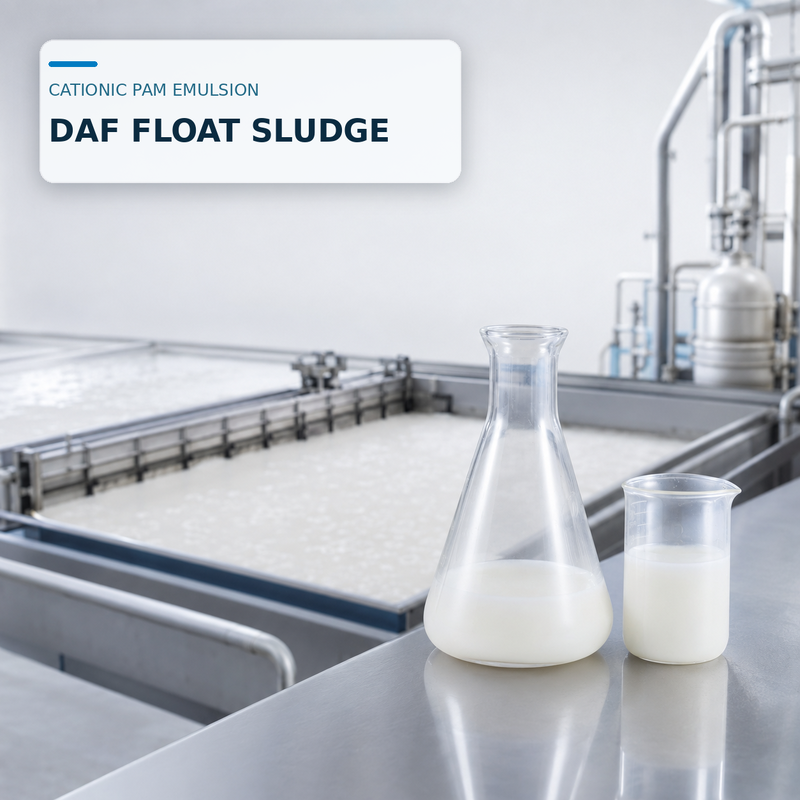
Cationic PAM Emulsion for DAF Float Sludge Thickening and Dewatering

High-molecular-weight liquid polymer grades for dilute, buoyant DAF float sludge containing fats, fibers, biological solids, or coagulant precipitates, supporting improved thickening, water release, floc integrity, and mechanical dewatering.

DAF Float Sludge Greasy and Fibrous Solids Improved Thickening Better Water Release

Product at a Glance

  • Product Cationic polyacrylamide emulsion
  • Application DAF float sludge
  • MW High
  • Charge Medium to very high
  • Selection Laboratory and plant trial
Product Introduction

Conditioning Low-Density DAF Float Sludge

DAF float sludge is often dilute, buoyant, and rich in fats, fibers, biological solids, or coagulant precipitates. Its response depends strongly on the upstream coagulant, pH, recycle pressure, and skimming practice.

The dewatering polymer should be selected on the float sludge itself, not only on raw wastewater. A grade that improves flotation may not be the best conditioner for the separated sludge.

CPAM for DAF Sludge Conditioning

Blufloc cationic polyacrylamide emulsion helps consolidate low-density, high-organic solids before thickening or mechanical dewatering.

Medium- to very-high-charge grades can be screened around the actual upstream coagulant, residual charge, DAF chemistry, transfer shear, and final dewatering objective.

Application Challenges

Common DAF Float Sludge Conditioning Problems

Low solids, water-retaining organics, changing residual coagulant, and transfer shear can all change the observed polymer response.

01

Low Feed Solids

Dilute float sludge may thicken slowly under gravity and deliver unstable feed solids to the mechanical dewatering machine.

02

Greasy or Fibrous Sludge

Fats, oils, fibers, and biological solids can retain water and produce weak, sticky, or difficult-to-dewater sludge.

03

Changing Charge Demand

Changes in upstream inorganic or organic coagulant dose can shift the residual charge and preferred CPAM grade.

04

Fragile Transfer Floc

Floc can break during pumping from the DAF unit to the thickener or dewatering machine, reducing capture and water release.

Treatment Mechanism

How the PAM Emulsion Works

Cationic PAM conditions fine, negatively charged float solids through charge neutralization and polymer bridging. The target is a cohesive but porous floc that survives transfer and releases water.

Step 01

Charge Neutralization

Cationic sites adsorb onto negatively charged float solids and reduce repulsion between fine color-bearing, biological, oily, fibrous, or precipitated particles.

Step 02

Particle Bridging

High-molecular-weight chains connect destabilized particles, creating a larger, cohesive structure for thickening and dewatering.

Step 03

Transfer and Water Release

Properly conditioned floc retains integrity through transfer, thickens more consistently, and releases water during mechanical dewatering.

Selection principle: Residual upstream coagulant can lower or reverse the apparent charge demand. Adjacent charge grades should therefore be screened rather than assuming that the highest-charge polymer will give the best result.
Important: The suggested grades below are starting candidates rather than a fixed prescription. Final grade selection and dosage require representative laboratory testing and a controlled plant trial.
Grade Selection

Recommended Blufloc Screening Grades

Compare adjacent grades on the actual DAF float sludge using the same active-mass basis, dilution water, preparation procedure, mixing, temperature, upstream coagulant conditions, and dewatering method.

Grade Base Molecular Weight Charge Suggested Screening Role
EC 8040 Oil-based High Medium Candidate when upstream coagulation already supplies substantial positive charge.
EC 8050 Oil-based High High Broad screening grade for DAF float sludge thickening and dewatering.
EWC 8060 Water-based High Very high Candidate for high-organic float sludge in compatible water-based preparation and dosing systems.
Blufloc cationic EC and EWC series are classified as high molecular weight, while the anionic EA and EWA grades are classified as very high molecular weight. Exact active content, viscosity, commercial specification limits, shelf life, and preparation instructions should be confirmed using the current grade-specific TDS and order specification.
Product Advantages

Benefits for DAF Float Sludge Dewatering

01

Compatible Charge Range

Medium-, high-, and very-high-charge candidates can be screened around different DAF coagulant programs and residual charge.

02

Flexible Liquid Feed

Pumpable emulsion form supports controlled dosing where float sludge production and solids concentration vary.

03

Improved Thickening

Correct conditioning can accelerate free-water separation and produce more stable feed solids before mechanical dewatering.

04

Better Floc Integrity

A well-matched polymer can help the floc withstand transfer pumps between the DAF, thickener, and dewatering equipment.

05

Screening and Scale-Up Support

Adjacent grades can be screened around the complete DAF chemistry, sludge characteristics, and agreed dewatering indicators.

Application Process

Controlled DAF Float Sludge Trial Procedure

Sample Stable DAF Float Sludge

Take sludge samples after the DAF reaches stable operation. Record upstream coagulant and polymer doses, pH, recycle pressure, skimming conditions, and float sludge solids.

Screen the Actual Float Sludge

Compare adjacent polymers on the separated float sludge at its normal solids concentration using the same active polymer mass basis and preparation conditions.

Evaluate Thickening and Shear

Assess thickening rate, free-water release, floc openness, filtrate quality, and shear resistance before machine trials.

Stabilize Upstream Conditions

During scale-up, stabilize upstream pH, coagulant dose, DAF recycle, sludge feed solids, and transfer conditions while changing one polymer variable at a time.

Optimize the Complete Treatment Cost

Compare coagulation, flotation, thickening, dewatering throughput, cake quality, polymer use, and final sludge disposal as one operating system.

Product Selection Guidance

Start with EC 8050 as a broad DAF float sludge screening grade.

Include EC 8040 when an inorganic or organic upstream coagulant already supplies significant charge neutralization.

Test EWC 8060 for highly organic float sludge or where water-based handling is preferred and the preparation system is compatible.

Compare Active Polymer Mass and Total Operating Cost

Neat-emulsion price per kilogram can be misleading when products differ in active content, preparation efficiency, activation, working dose, and equipment throughput.

The comparison should also include thickening rate, machine throughput, cake or underflow quality, filtrate clarity, floc survival, operator adjustment, and downstream disposal cost.

Performance Evaluation

Operating Indicators to Record

Float Sludge Solids
Thickening Rate
Filtrate Quality
Cake Solids
Total Chemical Cost
Troubleshooting

Verify Upstream DAF Conditions Before Changing the Polymer

If polymer performance changes with no apparent difference in the float sludge, verify the upstream coagulant pump, pH, DAF recycle pressure, air saturation, skimming practice, feed solids, and dosing-equipment calibration.

Excess residual coagulant can alter or reverse the apparent charge demand, change the preferred polymer charge, and make historical dose comparisons misleading.

Inspect emulsion activation, dilution water, injection, mixing, transfer pumps, thickening conditions, and dewatering-machine settings before concluding that the grade itself is no longer suitable.

Supply Options

Packaging

25 kg Container
200 kg Plastic Drum
1000 kg IBC
Safe Handling

Storage and Handling

  • Keep the original package tightly sealed.
  • Store in a cool, dry, and ventilated area.
  • Protect the emulsion from direct sunlight.
  • Prevent freezing and exposure to excessive heat.
  • Follow the grade-specific TDS and SDS for shelf life, handling limits, storage, and transport classification.
  • Contain and clean spills promptly because wet polymer can make floors extremely slippery.
25+ Years Water-treatment chemical manufacturing experience supported by three modern production plants.
100+ Markets Products supplied to customers in more than 100 countries and regions.
Manufacturer Support

Why Choose Bluwat Chemicals

  • More than 25 years of water-treatment chemical manufacturing experience supported by three modern production plants.
  • More than 800,000 tons delivered and exports to over 100 countries and regions, according to the company website.
  • Factory-direct coordination for grade selection, batch documentation, packaging, and export logistics.
  • Laboratory screening support using representative customer sludge or wastewater samples.
  • Recommendations developed according to the actual DAF chemistry, thickening, water release, floc integrity, filtrate, cake, throughput, and operating-cost objectives.
  • TDS, SDS, COA, and applicable certification documents available for the selected grade and destination market.
Technical Service

Quality Control and Technical Support

01

Specification Confirmation

Confirm the required commercial grade specification and order documentation before production and shipment.

02

Representative Sample Screening

Shortlist products using representative float sludge under realistic upstream coagulant, pH, temperature, solids, dilution-water chemistry, and transfer shear.

03

Preparation Recommendation

Provide make-down, dilution, activation, dosing, injection, and scale-up guidance for the selected grade.

04

Plant-Trial Review

Review trial data and adjust charge level, dose, addition point, mixing, transfer, thickening, machine settings, or upstream chemical stability.

Frequently Asked Questions

DAF Float Sludge PAM Emulsion FAQ

Should the polymer be selected on raw wastewater or DAF sludge?

For thickening and dewatering, test the separated float sludge because its solids concentration, residual coagulant, charge, and water-retention behavior differ from the influent.

Can upstream coagulant change the best CPAM grade?

Yes. Residual positive charge and coagulant precipitates can materially change polymer demand. Adjacent charge grades should be re-screened when the coagulant program changes.

Is thickening useful before mechanical dewatering?

Often yes. Higher and more stable feed solids can improve dewatering capacity, reduce hydraulic variability, and make polymer control more consistent.

Can one emulsion be used for both DAF and sludge dewatering?

Sometimes, but each duty should be tested independently. The best polymer for wastewater flotation may not provide the best thickening, floc strength, water release, or cake quality on the separated float sludge.

DAF Float Sludge Polymer Screening and Trial Support

For DAF float sludge thickening and dewatering, Bluwat can screen adjacent PAM emulsion grades, review preparation and dosing conditions, and help define a controlled plant-trial plan using float sludge solids, thickening rate, filtrate quality, cake solids, floc integrity, total chemical cost, and active polymer dose as agreed performance indicators.