logo
Good price  online

products details

Created with Pixso. Home Created with Pixso. Products Created with Pixso.
Polyelectrolyte Flocculant
Created with Pixso. CPAM Emulsion Flocculant for Paper Mill Sludge Dewatering

CPAM Emulsion Flocculant for Paper Mill Sludge Dewatering

Brand Name: BLUWAT
Model Number: Blufloc Emulsion
MOQ: 1000kgs
Price: negotiable
Delivery Time: 5-10days
Detail Information
Place of Origin:
China
Certification:
ISO9001
Product Name:
Cationic Polyacrylamide Emulsion
Abbreviation:
CPAM Emulsion
Product Category:
Water-Soluble Polymer Flocculant
Chemical Type:
Cationic Polyacrylamide Copolymer
Physical Form:
Liquid Emulsion
Appearance:
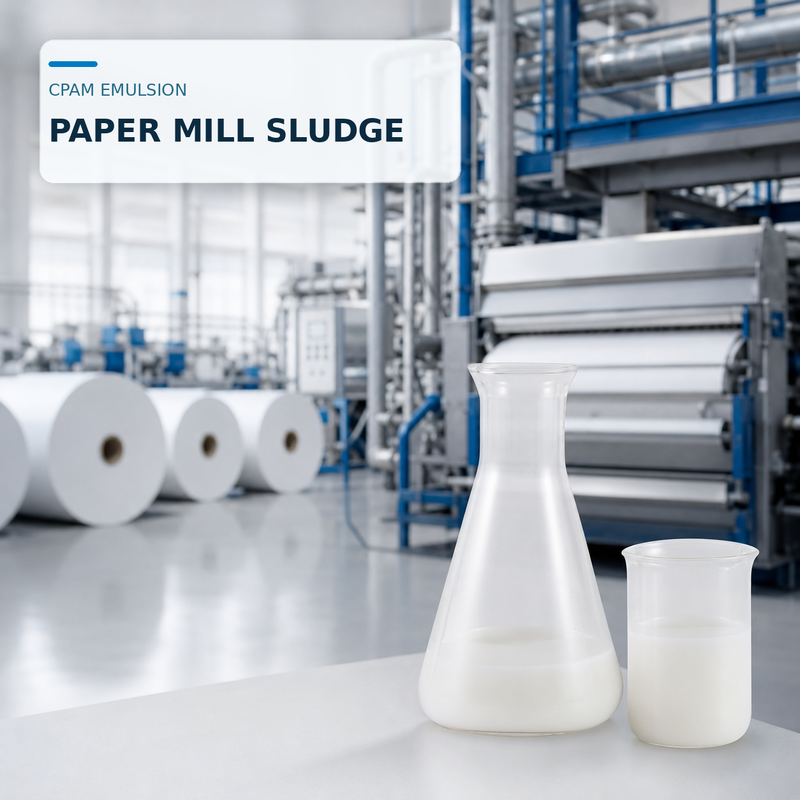
Milky White Or Off-White Emulsion
Available Formulations:
Oil-Based Emulsion And Water-Based Emulsion
Molecular Weight:
High
Charge Degree:
Medium To Ultra-High
Main Functions:
Flocculation, Sludge Conditioning, Dewatering And Clarification
Packaging Details:
30kgs, 50kgs, 250kgs, 1250kgs drums
Product Description
Blufloc PAM Emulsion

Cationic PAM Emulsion for Paper Mill Sludge Thickening and Dewatering

High-molecular-weight liquid polymer grades for paper mill sludge containing fibers, fillers, fines, coating pigments, starch, and biological solids, supporting faster drainage, stronger solids capture, and more consistent mechanical dewatering.

Paper Mill Sludge Fiber and Filler Capture Primary and Biological Sludge Consistent Dewatering

Product at a Glance

  • Product Cationic polyacrylamide emulsion
  • Application Paper mill sludge dewatering
  • MW High
  • Charge Medium, high, and very high
  • Selection Laboratory and plant trial
Product Introduction

Conditioning Variable Paper Mill Sludge

Paper mill sludge can contain highly variable ratios of fiber, clay, calcium carbonate, coating pigment, starch, and biological solids. Grade changes and production upsets can quickly alter its charge demand, floc structure, drainage, and final dewatering behavior.

A cationic emulsion can capture anionic fines and biological material, but the polymer should be selected according to whether the feed is predominantly primary fiber sludge, secondary biological sludge, or a changing blend of both.

CPAM for Paper Mill Sludge

Blufloc cationic PAM emulsion conditions paper mill sludge containing fibers, fillers, fines, coating pigments, starch, and biological solids before mechanical dewatering.

Multiple charge grades support screening for faster drainage, stronger solids and fiber capture, resilient floc, clearer filtrate, and more consistent cake formation as mill production changes.

Application Challenges

Common Paper Mill Sludge Conditioning Problems

Furnish, filler, coating, retention chemistry, and the primary-to- biological sludge ratio can all change the optimum CPAM grade and dose.

01

Fines in Filtrate

Clay, calcium carbonate, coating pigment, and short fibers can escape into filtrate when charge and bridging are insufficient.

02

Variable Drainage

Furnish, paper grade, filler loading, broke, and coating changes can quickly alter drainage and cake formation.

03

Biological-Rich Blends

Secondary sludge and dissolved anionic material can raise cationic demand and increase polymer use in blended feeds.

04

Floc Damage

Transfer pumps, fan pumps, recirculation, and excessive mixing can break conditioned floc and reduce solids capture.

Treatment Mechanism

How the PAM Emulsion Works

Cationic groups adsorb onto anionic fibers, mineral fines, coating particles, starch-related solids, and microbial material. Long polymer chains then bridge these components into drainable floc.

Step 01

Charge Neutralization

Cationic sites adsorb onto negatively charged fiber surfaces, filler particles, coating fines, and biological solids, reducing electrostatic repulsion.

Step 02

Particle Bridging

High-molecular-weight chains connect destabilized particles, creating larger, open floc that can retain fines while allowing water to drain.

Step 03

Drainage and Floc Resilience

The selected grade should form floc that survives realistic transfer shear, releases water efficiently, and limits fiber and filler loss to filtrate.

Selection principle: Fiber-rich primary sludge may respond to moderate charge, while biological-rich blended sludge can require higher charge. Adjacent grades should be screened rather than assuming that one charge level will cover every paper-production condition.
Important: The suggested grades below are starting candidates rather than a fixed prescription. Final grade selection and dosage require representative laboratory testing and a controlled plant trial.
Grade Selection

Recommended Blufloc Screening Grades

Compare adjacent grades on representative primary, secondary, and blended sludge using the same active-mass basis, dilution water, preparation procedure, pH, temperature, feed solids, shear, and dewatering method.

Grade Base Molecular Weight Charge Suggested Screening Role
EC 8040 Oil-based High Medium Starting candidate for fiber- and filler-rich primary sludge.
EC 8050 Oil-based High High Broad starting candidate for blended paper mill sludge.
EC 8060 Oil-based High Very high Candidate for biological-rich or highly anionic sludge.
Blufloc cationic EC and EWC series are classified as high molecular weight, while the anionic EA and EWA grades are classified as very high molecular weight. Exact active content, viscosity, commercial specification limits, shelf life, and preparation instructions should be confirmed using the current grade-specific TDS and order specification.
Product Advantages

Benefits for Paper Mill Sludge Dewatering

01

Charge Options

Adjacent grades support changing fiber-to-biosolids ratios and variable anionic demand.

02

Filtrate and Fiber Capture

Correct conditioning can improve filtrate clarity and limit the loss of fibers, filler fines, and biological solids.

03

Rapid Make-Down

Fast emulsion activation supports continuous mill operation and controlled response to production changes.

04

Multiple Dewatering Duties

Grades can be screened for belt press, screw press, and centrifuge operation under representative shear.

05

Production-Linked Screening

Screening can be linked to paper grade, furnish, coating, ash, and primary-to-biological sludge contribution.

Application Process

Controlled Paper Mill Sludge Trial Procedure

Characterize Sludge Contribution

Identify the primary fiber, secondary biological, and blended sludge contribution. Note the current paper grade, furnish, filler, coating, and upstream retention chemistry.

Record Operating Conditions

Record ash, feed solids, pH, temperature, dilution-water quality, and the current furnish or coating grade where these data are available.

Screen Adjacent Charges

Compare adjacent cationic charges on the same active-mass basis. Observe drainage, floc resilience, filtrate solids, fiber capture, and cake formation.

Run a Controlled Machine Trial

Trial the best two candidates while feed solids, paper grade, machine settings, preparation, and dose calibration remain as stable as practical.

Define Production Windows

Create separate grade or dose setpoints for fiber-rich and biological-rich operating periods when one setting cannot consistently cover both conditions.

Product Selection Guidance

EC 8040 can be an efficient starting candidate for fiber-rich primary sludge that already forms structure.

EC 8050 is a broad starting point for blended paper mill sludge containing both fibers and biological material.

Include EC 8060 when secondary sludge, soluble anionic material, or high biological content raises charge demand.

Compare Active Polymer Mass and Total Operating Cost

Neat-emulsion price per kilogram can be misleading when products differ in active content, preparation efficiency, activation, working dose, and equipment throughput.

The comparison should also include machine throughput, cake or underflow quality, filtrate TSS, fiber loss, floc survival, operator adjustment, and downstream disposal cost.

Performance Evaluation

Operating Indicators to Record

Filtrate TSS
Fiber Loss
Cake Solids
Throughput
Polymer Cost per Dry Ton
Troubleshooting

Link Performance Changes to Paper Production

If drainage, capture, or cake performance follows paper-grade changes, sample the sludge during every major furnish, filler, or coating condition. A single average sample can conceal the need for two distinct operating windows.

Check whether a retention-aid, strength-agent, sizing, broke, or coating-chemistry change upstream is also altering sludge charge, ash content, and the fines entering wastewater treatment.

Inspect emulsion activation, dilution water, injection point, mixing, transfer and fan pumps, feed-solids consistency, and dewatering-machine settings before concluding that the selected grade is no longer suitable.

Supply Options

Packaging

25 kg Container
200 kg Plastic Drum
1000 kg IBC
Safe Handling

Storage and Handling

  • Keep the original package tightly sealed.
  • Store in a cool, dry, and ventilated area.
  • Protect the emulsion from direct sunlight.
  • Prevent freezing and exposure to excessive heat.
  • Follow the grade-specific TDS and SDS for shelf life, handling limits, storage, and transport classification.
  • Contain and clean spills promptly because wet polymer can make floors extremely slippery.
25+ Years Water-treatment chemical manufacturing experience supported by three modern production plants.
100+ Markets Products supplied to customers in more than 100 countries and regions.
Manufacturer Support

Why Choose Bluwat Chemicals

  • More than 25 years of water-treatment chemical manufacturing experience supported by three modern production plants.
  • More than 800,000 tons delivered and exports to over 100 countries and regions, according to the company website.
  • Factory-direct coordination for grade selection, batch documentation, packaging, and export logistics.
  • Laboratory screening support using representative customer sludge or wastewater samples.
  • Recommendations developed according to the actual sludge blend, furnish, ash, drainage, floc resilience, filtrate TSS, fiber capture, cake, throughput, and operating-cost objectives.
  • TDS, SDS, COA, and applicable certification documents available for the selected grade and destination market.
Technical Service

Quality Control and Technical Support

01

Specification Confirmation

Confirm the required commercial grade specification and order documentation before production and shipment.

02

Representative Sample Screening

Shortlist products using representative primary, secondary, and blended sludge under realistic pH, temperature, solids, ash, dilution-water chemistry, and transfer shear.

03

Preparation Recommendation

Provide make-down, dilution, activation, dosing, injection, and scale-up guidance for the selected grade.

04

Plant-Trial Review

Review trial data and adjust charge level, dose, addition point, mixing, transfer, machine settings, or production-linked operating windows.

Frequently Asked Questions

Paper Mill Sludge PAM Emulsion FAQ

Does paper mill sludge always need high-charge CPAM?

No. Fiber-rich primary sludge may perform well with moderate charge, while biological-rich sludge and highly anionic blends often require higher charge.

Can the same grade handle coated and uncoated paper production?

Possibly, but coating pigments, filler loading, furnish, and wet-end chemistry can change the optimum charge and dose. Confirm performance with representative samples.

What should be recorded during a mill trial?

Record feed solids, ash or sludge type, primary-to-biological contribution, paper grade, filtrate TSS, fiber loss, cake solids, throughput, and active polymer mass.

Can improved capture return more fiber to the process?

Dewatering polymer mainly conditions the sludge. Any fiber- recovery or process-return strategy should be evaluated separately with the production, wastewater, and product- quality teams.

Paper Mill Sludge Polymer Screening and Trial Support

For paper mill primary, secondary, and blended sludge dewatering, Bluwat can screen adjacent PAM emulsion grades, review preparation and dosing conditions, and help define a controlled plant-trial plan using filtrate TSS, fiber loss, cake solids, throughput, floc resilience, and active polymer cost per dry ton as agreed performance indicators.