| Brand Name: | BLUWAT |
| Model Number: | Blufloc Emulsion |
| MOQ: | 1000kgs |
| Price: | negotiable |
| Delivery Time: | 5-10days |
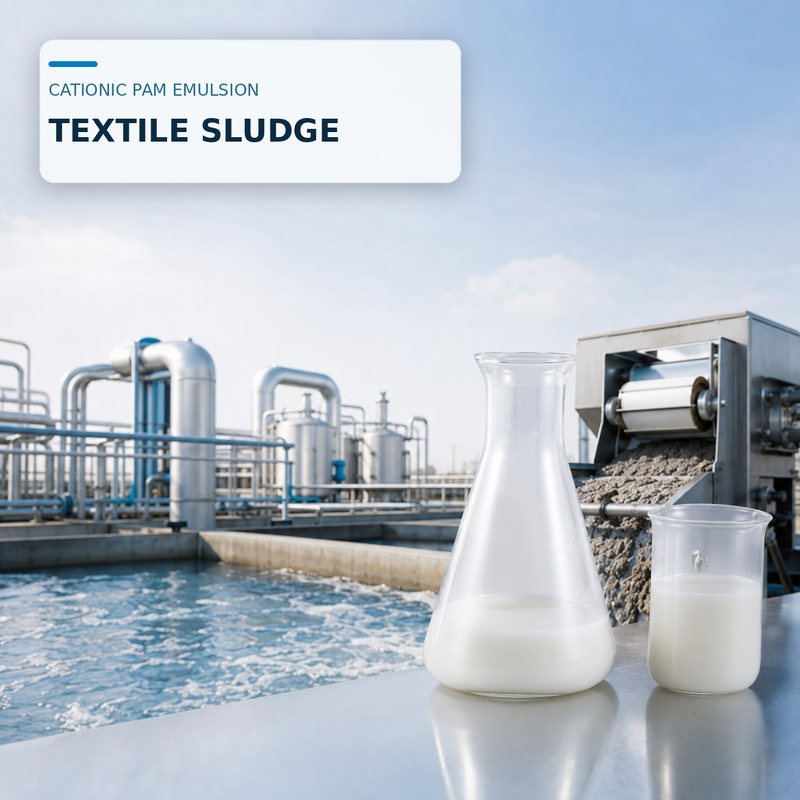
High-molecular-weight liquid polymer grades for dyehouse sludge containing biological solids, dye residues, decoloring-agent floc, and inorganic coagulant precipitates, supporting stronger capture and more consistent mechanical dewatering.
Textile sludge carries the history of the upstream treatment train. Dyes, auxiliaries, salts, PAC or ferric precipitates, decoloring agents, and biological solids can all affect polymer demand, drainage, filtrate color, and cake formation.
The dewatering polymer should be evaluated only after the color-removal chemistry is stable. Otherwise, a change in BWD, PAC, ferric coagulant, or pH can be mistaken for a change in CPAM performance.
Blufloc cationic PAM emulsion consolidates biological solids, dye residues, and coagulant floc after wastewater color and COD treatment.
Grades are screened around the plant's decolorization chemistry, PAC or ferric dose, pH control, salt load, sludge source, and dewatering equipment.
Dye class, shade depth, production recipe, salinity, biological contribution, and residual upstream chemicals can all shift the optimum CPAM charge and dose.
Mixed organic and inorganic solids respond differently as BWD, PAC, ferric salts, pH, and biological sludge ratios change.
Fine dye-bearing particles can remain in filtrate or centrate when charge neutralization, bridging, or upstream coagulation is incomplete.
High ionic strength and variable pH can alter polymer conformation, floc development, drainage, and the effective dose window.
Shade, fiber, dye, auxiliary, and washing-recipe changes can alter the sludge faster than a single historical polymer setting can accommodate.
The cationic polymer adsorbs onto anionic biological solids and residual dye-bearing particles. Long chains then bridge these solids with coagulant precipitates to create larger, drainable floc.
Cationic sites adsorb onto negatively charged biological solids and color-bearing particles, reducing repulsion and destabilizing fine material.
High-molecular-weight chains connect destabilized solids with PAC, ferric, or decoloring-agent floc, producing larger structures that can release water.
The selected grade should survive realistic transfer shear, release water efficiently, and limit both suspended solids and visible color in filtrate or centrate.
Compare adjacent grades on representative dyehouse sludge using the same active-mass basis, dilution water, preparation procedure, pH, temperature, feed solids, salinity, upstream chemistry, shear, and dewatering method.
| Grade | Base | Molecular Weight | Charge | Suggested Screening Role |
|---|---|---|---|---|
| EC 8040 | Oil-based | High | Medium | Candidate when residual cationic decolorant or coagulant charge is significant. |
| EC 8050 | Oil-based | High | High | General starting candidate for blended textile sludge. |
| EC 8060 | Oil-based | High | Very high | Candidate for biological-rich or high-organic textile sludge. |
Adjacent charge grades support chemical, biological, and blended textile sludge with variable anionic demand.
Correct conditioning can improve the capture of fine dye-bearing particles and suspended solids in the return stream.
Rapid emulsion activation supports variable dyehouse schedules and controlled response to production changes.
Grades can be screened with the site's existing BWD, PAC, ferric, pH-adjustment, and sludge-dewatering program.
Product selection can be linked to actual dyehouse sludge, dominant dyes, color chemistry, salinity, and dewatering goals.
Stabilize BWD or other decoloring-agent dose, PAC or ferric dose, pH, settling, and sludge withdrawal before taking a representative sample.
Record the dominant dyes, shade or production change, sludge source, feed solids, pH, salinity, temperature, upstream chemical doses, and dilution-water quality.
Screen moderate-, high-, and very-high-charge candidates on the same active-mass basis. Observe drainage, floc resilience, cake formation, filtrate TSS, and return-stream color.
Trial the best candidates while upstream color treatment, feed solids, machine settings, preparation, dilution, and dosing calibration remain as stable as practical.
Establish dose windows for representative production conditions, then recheck them when dye shades, recipes, salinity, sludge blend, or upstream chemistry change materially.
Use EC 8050 as a general starting candidate for blended textile sludge after stable color and COD treatment.
Include EC 8040 when substantial residual cationic decolorant, PolyDADMAC, polyamine, PAC, or ferric-derived charge has already reduced the sludge's negative demand.
Include EC 8060 when biological solids or high organic content dominate and the lower-charge candidates do not provide adequate capture.
Neat-emulsion price per kilogram can be misleading when products differ in active content, preparation efficiency, activation, working dose, and equipment throughput.
The comparison should also include machine throughput, cake or underflow quality, filtrate color and TSS, floc survival, operator adjustment, sludge handling, and downstream disposal cost.
If dewatering changes with color treatment, first confirm BWD or other decoloring-agent dosing, PAC or ferric dosing, pH adjustment, settling, and sludge withdrawal. These changes alter sludge composition and residual charge.
Polymer overdosing can create sticky or gelatinous cake that is difficult to release from filter media. A clearer filtrate alone does not prove that a higher dose is economically or mechanically better.
Inspect emulsion activation, dilution water, injection point, mixing, transfer pumps, feed-solids consistency, and dewatering-machine settings. Resample after major shade, recipe, salt-load, or biological-treatment changes.
Confirm the required commercial grade specification and order documentation before production and shipment.
Shortlist products using representative dyehouse sludge under realistic pH, temperature, solids, salinity, upstream color- treatment chemistry, dilution-water quality, and transfer shear.
Provide make-down, dilution, activation, dosing, injection, and scale-up guidance for the selected grade.
Review trial data and adjust charge level, dose, addition point, mixing, transfer, machine settings, or operating windows linked to shade and upstream chemistry changes.
Its primary role on this page is sludge conditioning. Direct color removal normally requires a dedicated decoloring agent and, where appropriate, a coagulant before sludge dewatering.
They change sludge composition, precipitate loading, and residual charge. These changes directly affect the most suitable CPAM grade and dose.
Not necessarily, but high ionic strength can change polymer conformation, activation, floc development, and the optimum dose. Testing should therefore use actual plant sludge.
A robust grade may cover a practical operating range, but major shade, dye class, recipe, salinity, or upstream chemistry changes can require a different dose window or a new grade screen.
For textile dyeing sludge after color and COD treatment, Bluwat can screen adjacent PAM emulsion grades, review preparation and dosing conditions, and help define a controlled plant-trial plan using cake solids, filtrate color and TSS, polymer use, upstream coagulant dose, sludge handling, and total operating cost as agreed performance indicators.