| Brand Name: | BLUWAT |
| Model Number: | Blufloc Emulsion |
| MOQ: | 1000kgs |
| Price: | negotiable |
| Delivery Time: | 5-10days |
High-charge liquid polymer grades for protein-, fat-, starch-, fiber-, and biomass-rich sludge, supporting faster drainage, clearer return water, and stable dewatering across changing production and sanitation loads.
Food-processing sludge may contain proteins, fats, starch, fibers, fermentation biomass, cleaning chemicals, and DAF solids. Production schedules and sanitation cycles can create rapid swings in pH, temperature, solids composition, and organic loading.
A high-charge cationic emulsion is often a useful starting point, but fat-rich DAF sludge, biological sludge, and mixed primary sludge should be screened separately whenever practical.
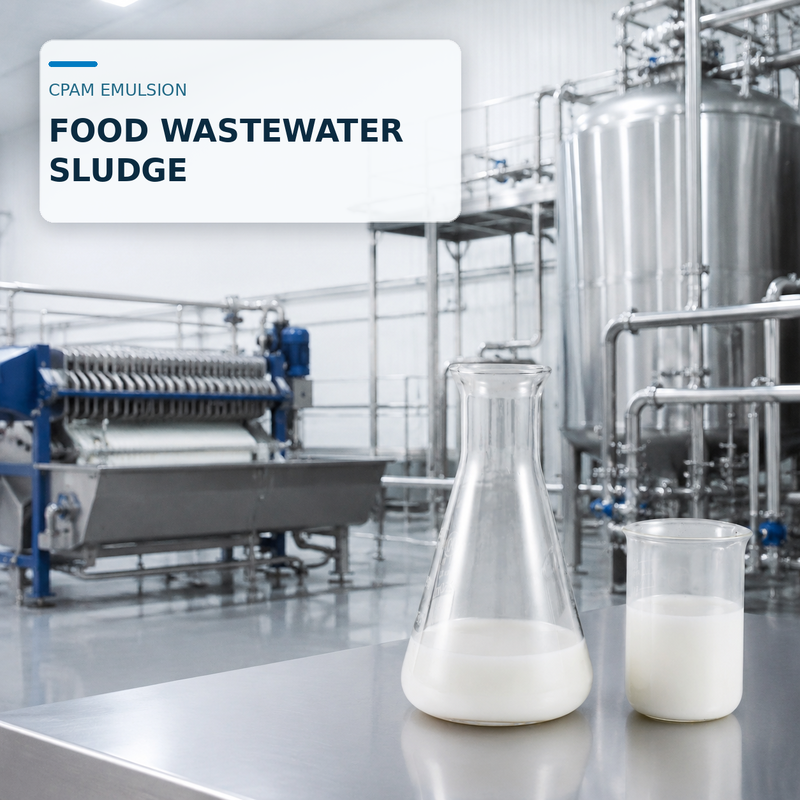
Blufloc CPAM emulsion conditions high-organic sludge from food-processing wastewater systems.
High- and very-high-charge grades can support faster drainage, clearer return water, improved solids capture, and stable dewatering across changing production loads.
Food type, fat state, biological activity, storage time, cleaning chemistry, temperature, pH, and upstream DAF operation can all change polymer demand and floc strength.
Proteins and biological polymers can hold substantial bound water, limiting drainage and cake solids.
Free or partially separated fat can coat particles, weaken floc, and create greasy cake or unstable filtrate.
Product changeover and sanitation cycles can rapidly shift pH, surfactant loading, temperature, and organic composition.
Warm, high-organic sludge can degrade quickly during storage, changing charge demand and dewatering response.
The cationic polymer adsorbs onto negatively charged organic solids and forms bridges between particles. Effective conditioning exposes free water and creates floc strong enough for the selected press or centrifuge.
Cationic sites adsorb onto negatively charged proteins, biological solids, fibers, and fine organic particles, reducing electrostatic repulsion.
High-molecular-weight chains connect destabilized particles into larger floc that can survive controlled pumping and mixing.
A cohesive but porous floc exposes free water for separation by centrifuge, belt press, screw press, or other dewatering equipment.
Compare candidates using the same active-polymer basis, preparation procedure, dilution water, pH, temperature, feed solids, sludge source, fat condition, shear, and dewatering method.
| Grade | Base | Molecular Weight | Charge | Suggested Screening Role |
|---|---|---|---|---|
| EC 8050 | Oil-based | High | High | Starting candidate for mixed food-processing sludge. |
| EC 8060 | Oil-based | High | Very high | Candidate for biological or protein-rich sludge. |
| EWC 8060 | Water-based | High | Very high | Water-based option for compatible hygienic dosing layouts and automated systems. |
High-charge options support protein-rich, biological, and mixed organic sludge with strong negative demand.
Pumpable emulsion supports continuous operation and faster response to production-linked loading changes.
Correct conditioning can improve solids capture, drainage, cake formation, and downstream handling.
EC and EWC options support different preparation, dosing, and site-handling preferences.
Technical trials can distinguish fat-rich DAF float sludge, biological sludge, and mixed primary sludge.
Collect samples during representative production and sanitation loads, not only during low-load or stable periods.
Record food type, sanitation cycle, temperature, pH, DAF chemistry, feed solids, sludge age, storage time, and dilution-water condition.
Where practical, screen candidates separately on DAF float sludge, biological sludge, and mixed primary sludge using equal active-polymer mass.
Optimize the centrifuge or press under stable feed, activation, dilution, injection, mixing, and machine-setting conditions.
Establish operating bands for normal production, peak load, product changeover, and cleaning periods, with clear triggers for re-screening.
EC 8050 is a practical baseline for mixed food-processing sludge.
Compare EC 8060 or EWC 8060 where biological solids, proteins, or high charge demand limit capture and drainage.
For greasy sludge, first confirm that upstream fat separation, skimming, coagulation, and pH control are working before increasing polymer dose.
Neat-emulsion price per kilogram can be misleading when products differ in active content, preparation efficiency, activation, dose, and equipment throughput.
The evaluation should also include cake or underflow quality, filtrate COD and TSS, capture, machine capacity, operator adjustment, sludge handling, and downstream disposal cost.
If sludge turns greasy or conditioning suddenly fails, check DAF skimming, fat-separation efficiency, sludge temperature, pH, and cleaning chemicals before changing the polymer program.
A higher polymer dose cannot reliably compensate for an upstream oil-separation upset. Excess dose may create sticky floc, poor cake release, or misleading short-term improvement.
Also inspect feed-solids consistency, sludge storage time, emulsion activation, dilution water, injection point, transfer shear, dosing calibration, and dewatering-machine settings.
Confirm the required commercial grade specification and order documentation before production and shipment.
Shortlist products using actual sludge under realistic pH, temperature, solids, fat state, DAF chemistry, sanitation chemistry, dilution-water quality, and shear.
Provide make-down, dilution, activation, dosing, injection, and scale-up guidance for the selected grade.
Review trial data and adjust charge level, dose, addition point, mixing, transfer, machine settings, or operating windows.
Potential applications include meat, dairy, beverage, starch, sugar, fermentation, and general food-processing wastewater sludge. Final grade selection requires testing on the actual sludge.
They may use the same grade, but their composition, fat content, solids concentration, and charge demand can differ enough that separate screening is preferred.
If it improves cake solids or capture at an economical dose, it may reduce the amount of water transported with the sludge. The result should be confirmed with site-specific operating and disposal data.
Yes. Changes in pH, surfactants, cleaners, temperature, and dissolved organic load during sanitation can change sludge charge, polymer demand, and flocculation performance.
For high-organic food wastewater sludge, Bluwat can screen adjacent PAM emulsion grades, review preparation and dosing conditions, and help define a controlled plant-trial plan using cake solids, capture, filtrate COD and TSS, polymer use, production condition, sludge handling, and total operating cost as agreed performance indicators.