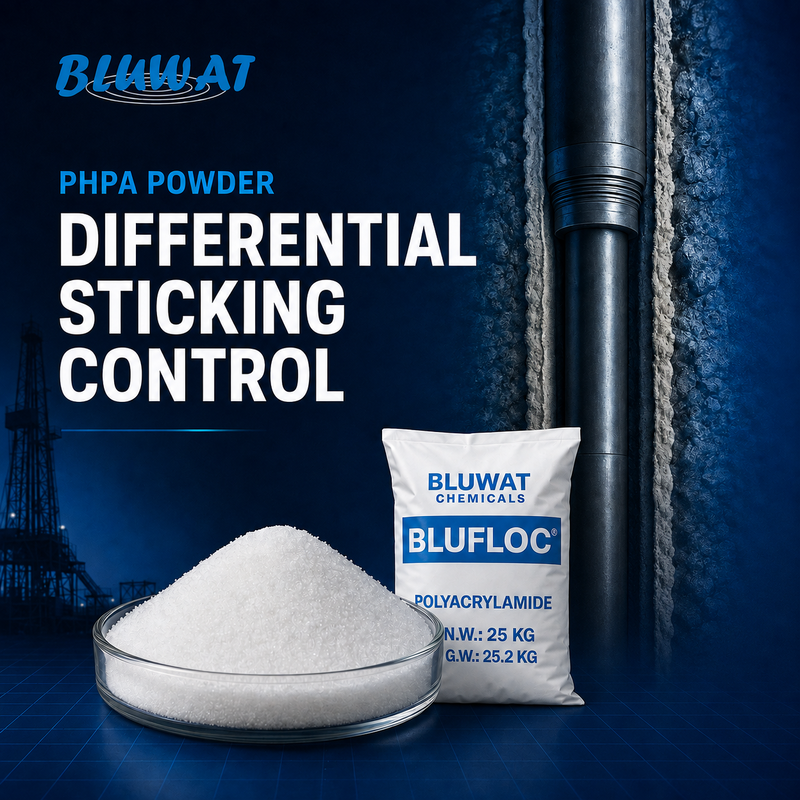
| Brand Name: | Blufloc |
| MOQ: | 500kgs |
| Price: | Negotiation |
| Delivery Time: | 10 working days after received your payment |
| Payment Terms: | T/T or L/C |
Differential sticking risk combines pressure differential, contact area, cake quality, pipe position, and fluid lubricity.
BLUFLOC powder PHPA is described in the supplied family TDS as a water-soluble copolymer of anionic character used in drilling-fluid and selected oilfield applications. The four powder grades span very-high and ultra-high molecular-weight classes with medium or high charge. The table does not assign a unique application to any grade, so the target duty, water, formation, mixing system, and representative test results must decide selection.
PHPA can adsorb on metal, clay, and solids surfaces and change the liquid-solid interface. A properly dissolved long chain may also reduce turbulent friction in suitable flowing systems. Lubricity and drag reduction are formulation-, flow-, salinity-, and shear-dependent and must be measured rather than inferred from polymer class alone.
Molecular-weight and charge classes describe broad polymer behavior, not a guaranteed field result. Powder dispersion, complete hydration, solution concentration, water quality, pH, solids, shear, aging, temperature, and companion chemistry can materially change observed performance.
Important selection note: The grades below are screening candidates, not a fixed prescription. Final grade, solution concentration, process dose, preparation, addition point, and acceptance criteria require current grade documentation and representative laboratory and field or plant trials.
| Grade | MW Class | Charge | Screening Position |
|---|---|---|---|
| HA6518 | Very High | Medium | Screening candidate; selection requires representative testing |
| HA8520 | Very High | High | Screening candidate; selection requires representative testing |
| HAA6520 | Ultra High | Medium | Screening candidate; selection requires representative testing |
| HAA7525 | Ultra High | High | Screening candidate; selection requires representative testing |
| Powder Grade | Molecular Weight Class | Charge Class |
|---|---|---|
| HA6518 | Very High | Medium |
| HA8520 | Very High | High |
| HAA6520 | Ultra High | Medium |
| HAA7525 | Ultra High | High |
| Family TDS Item | Powder Product Value or Guidance |
|---|---|
| Product form | Powder |
| Appearance | White powder |
| Solid content | 89% min |
| Bulk density | About 0.8 |
| Specific gravity at 25 degrees C | 1.01-1.10 |
| Shelf life | 2 years |
| Packaging | 25 kg kraft paper bags with inner PE liners, palletized |
| Recommended solution concentration | 0.1-0.3% solids |
| Recommended make-up water temperature | 10-40 degrees C |
| Effective pH range | 5-14 |
| TDS mixing guidance | About 1 hour; propeller stirrer at 200-500 rpm |
TDS confirmation note: Exact active content, viscosity, specification limits, shelf life, and preparation instructions should be confirmed on the current grade-specific TDS and order specification.
The supplied family TDS recommends preparing powder PHPA at 0.1-0.3% solids with make-up water at 10-40 degrees C and an effective pH range of 5-14. Efficient dispersion is required; a polymer eductor or commercial dry-powder feeder is suggested. After dispersion into agitated water, continue stirring for about one hour. The TDS notes a propeller-type stirrer at 200-500 rpm and recommends separate stock make-up and solution holding tanks. The prepared anionic solutions are described as stable for up to one week. Aluminum, zinc, copper, and iron should be avoided in the make-up system. Confirm all details against the current grade-specific TDS, SDS, equipment manual, and order specification.
Scale-up warning: Do not scale a laboratory rpm directly to a full tank. Validate impeller, tank geometry, feed distribution, water flow, residence time, shear, and solution quality at the intended production rate.
Potential fit for PHPA powder for mud cake friction after representative qualification.
Four TDS-listed molecular-weight and charge class combinations for comparative screening.
Powder format with at least 89% solids stated in the family TDS.
PHPA-family compatibility statement covering biopolymers, PAC, and CMC, subject to formulation testing.
Palletized 25 kg lined bag format for storage, export, and controlled field make-down.
Separate mechanical contributors from fluid contributors using trajectory, hole condition, cuttings, and hydraulics data.
Measure baseline lubricity, rheology, filtration, and circulating or loop pressure behavior.
Prepare candidate grades fully and compare them on active solids with the complete fluid package.
Age and shear treated fluids under representative salinity, temperature, solids, and flow conditions.
Confirm the treatment in a controlled field interval or stage with predefined acceptance and stop criteria.
Use cake, filtration, lubricity, and mechanical risk together rather than attributing control to one polymer function.
Compare candidates on polymer solids and achieved operating outcome. Price per bag can be misleading when hydration, make-down losses, dose, equipment throughput, drilling response, fluid recovery, waste, logistics, and downstream costs differ.
If performance drifts: If the cake becomes thicker after treatment, rebalance filtration solids and polymer even when fluid loss decreases.
The supplied TDS states that powder products are packed in 25 kg kraft paper bags with inner PE liners and are palletized. Store unopened material in its original packaging in a cool, dry place away from heat, flame, and direct sunlight. The family table states a two-year shelf life for powder products. Protect opened bags from moisture and contamination. Follow the current SDS for personal protection, dust control, spill cleanup, transport, and disposal. Wet polymer is extremely slippery; contain and clean spills promptly.
For PHPA powder for mud cake friction, Bluwat can review the target duty, water and formation data, make-down equipment, proposed test methods, and the four TDS-listed powder classes with the customer. Company-level certifications or management-system documents should not be represented as grade-specific application approvals unless the applicable certificate explicitly says so.
No. It can influence cake and lubricity, but pressure and operational exposure remain.
Record connections, static time, overpull, torque, fluid loss, cake properties, and treatment changes.
No. It may influence interfacial behavior, but dedicated lubricants can use different mechanisms and should be compared in the same mud.
No. A friction loop or representative field test is required for any numerical claim.
Share the target duty, formation and water data, mud formulation, make-down equipment, and proposed test method. Bluwat can help compare the four TDS-listed powder classes under representative conditions.
Request Grade Screening and Current TDS